

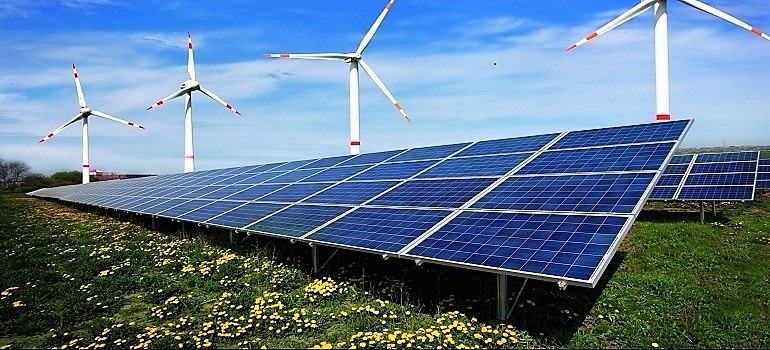
How wind-solar hybrid systems with storage are shaping the future of clean, reliable, and flexible energy in India and beyond.
As the world accelerates towards decarbonization, hybrid renewable energy systems— a combination of wind, solar, and storage—are emerging as the backbone of next-gen clean power. They represent a strategic evolution in how we produce, store, and dispatch power, moving from static generation to systems that respond dynamically to demand.
Synergy in Action: When Sun, Wind, and Storage Sync Up
Solar and wind each bring distinct strengths—solar generation peaks during the day, while wind often intensifies after dark or in cloudy conditions. When integrated with battery storage, these resources move from being variable to forming a stable, dispatchable supply of power. This complementarity is not a convenience; it is a structural shift that underpins the next generation of energy systems. It enables grids that are more agile, reliable, and responsive—capable of meeting demand consistently across both dense urban centers and remote communities.
India’s Hybrid Moment: Turning Policy into Progress
India is advancing towards a decisive vision for round-the-clock clean energy. More than 65 GW of hybrid, RTC, and bundled renewable projects are already tendered or under development, with states such as Rajasthan, Gujarat, and Tamil Nadu setting the pace through progressive hybrid policies. Supportive measures—including viability gap funding, streamlined land clearances, and priority grid access—are accelerating the transition from plan to execution. Taken together, these efforts signal a strategic shift: reducing coal dependence, strengthening energy security, and building a flexible grid capable of integrating ever-greater shares of renewable power.
Why Hybrids Win: Flexibility, Efficiency, and Resilience
To deliver on this vision, India requires solutions that move beyond standalone solar or wind. Hybrid models—integrating renewables with storage and digital controls—provide exactly that. By turning variable resources into firm, dispatchable power, they enhance grid stability while keeping costs competitive.
In practice, hybrid systems combine solar and wind generation with storage and smart inverters, connected through managed interfaces that enable real-time load balancing. Their strength lies in versatility: capable of running on-grid or off-grid, they are equally suited to powering remote communities, stabilizing urban rooftops, or building resilient, emergency-ready microgrids.
Hybrid Power: The Next Frontier of Energy Systems
The future of energy will not be defined by a single source but by the intelligence and flexibility of hybrid systems. Solar, wind, hydro, and storage each play a distinct role; it is in their combination that we unlock a power system that is not only low-carbon but also resilient, affordable, and reliable.
Storage is the critical enabler. By making every unit of renewable power available when demand is highest, it transforms variable generation into dependable supply. At the same time, hybrid systems drive efficiency by optimizing shared infrastructure—land, transmission corridors, grid connections, and even operations and maintenance—lowering lifecycle costs compared to stand-alone projects.
Challenges Ahead: A Rapidly Evolving Ecosystem
Despite their potential, hybrid systems face few challenges:
• Technical integration of multiple generation and storage components
• Higher upfront capital investments
• Regulatory frameworks still evolving beyond single-source renewable models
But the ecosystem is responding, and solutions are emerging fast. With advanced hybrid inverters, AI-powered energy management systems, and grid-aware storage technologies, barriers are rapidly being overcome. As developers gain experience, soft costs are falling, and implementation timelines are accelerating.
AUTHOR

Dhananjay Kumar, Director of Corporate Affairs at ENGIE