

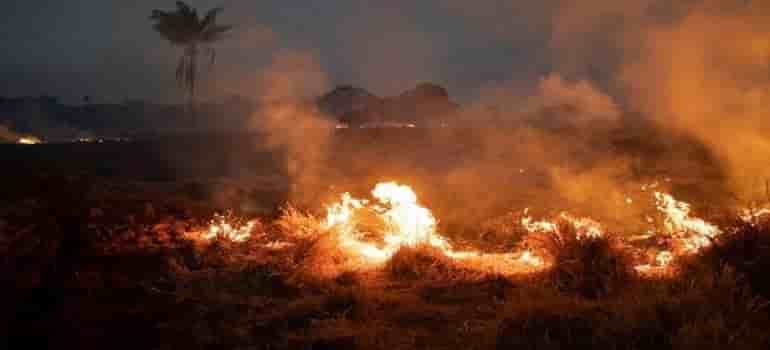
NASA Scientists warn later-day crop fires may be worsening overnight smog episodes across the Indo-Gangetic Plain
Every winter, vast plumes of smoke blanket the Indo-Gangetic Plain as farmers across Punjab, Haryana, Uttar Pradesh and neighbouring states burn crop residue after the rice harvest. But satellite observations now show a significant change in when these fires are lit—one that could be intensifying air pollution episodes in cities like Delhi.
According to atmospheric scientists tracking India’s stubble burning season, crop fires are increasingly occurring later in the day compared to previous years. This behavioural shift, detected through high-frequency satellite monitoring, may be contributing to severe nighttime and early-morning pollution spikes during the winter months.
A familiar pollution season, with a new twist
The broad seasonal pattern remains unchanged. Air quality typically worsens from late October through November as crop fires intensify and weather conditions turn unfavourable. In 2025, Delhi and several northern cities experienced a sharp decline in air quality for nearly a month after burning accelerated in the final week of October.
On November 11, 2025, satellite imagery captured dense haze stretching across much of northern India. Pollution levels crossed 400 on India’s Air Quality Index on multiple days—classified as “severe”—prompting authorities to shut schools in some regions and tighten restrictions on construction activities.
Stubble burning continues to mix with emissions from vehicles, industries, domestic fuel use, fireworks and dust, creating a toxic cocktail. However, scientists consistently identify crop residue fires as a major seasonal driver of the haze.
Fires are happening later—and many are going undetected
What has changed is the daily timing of these fires. Earlier, most stubble burning occurred in the early afternoon, typically between 1 pm and 2 pm. That pattern has steadily shifted over the past few years.
New analysis using data from geostationary satellites—which observe the same region every few minutes—shows that most fires now occur between 4 pm and 6 pm. This shift means many fires are missed by conventional polar-orbiting satellites that pass over the region only once or twice a day.
Scientists say this indicates a clear change in farmer behaviour, possibly driven by enforcement patterns, labour availability or attempts to avoid detection.
2025 fire activity: moderate, but still concerning
Satellite-based assessments suggest that stubble burning activity in Punjab and Haryana during 2025 was moderate compared to recent years. Fire counts were higher than in 2019, 2020 and 2024, but lower than peak years such as 2021, 2022 and 2023.
Independent studies by Indian and international research institutions have confirmed the same trend. Multi-satellite analyses show that peak fire activity has shifted from early afternoon earlier in the decade to early evening by the mid-2020s.
Why evening fires may worsen air pollution
The timing of crop fires plays a critical role in how pollution behaves. Evening and nighttime fires coincide with a shallower planetary boundary layer—the lowest part of the atmosphere—when winds are weaker and temperatures drop. These conditions trap pollutants closer to the ground, allowing particulate matter to accumulate overnight.
As a result, smoke released in the evening may lead to higher pollution levels the following morning compared to fires lit earlier in the day, when stronger sunlight and air movement help disperse emissions.
How much do stubble fires contribute to Delhi’s smog?
The exact share of stubble burning in Delhi’s pollution remains debated. Scientific estimates vary widely, ranging from 10 percent to as high as 50 percent during peak episodes. On particularly bad days, crop fires can dominate pollution levels, while their annual average contribution is much lower.
Experts caution that meteorology plays a decisive role. Cold temperatures, calm winds and low mixing heights during winter amplify the impact of all pollution sources—not just farm fires.
What this means for policy and monitoring
The shift toward evening burning highlights gaps in current fire-monitoring systems and raises questions about enforcement effectiveness. Scientists stress the need for improved satellite surveillance, better ground-level monitoring and stronger incentives for farmers to adopt residue management alternatives.
As India grapples with recurring winter smog crises, understanding when pollution is released may prove just as important as understanding how much is emitted.