

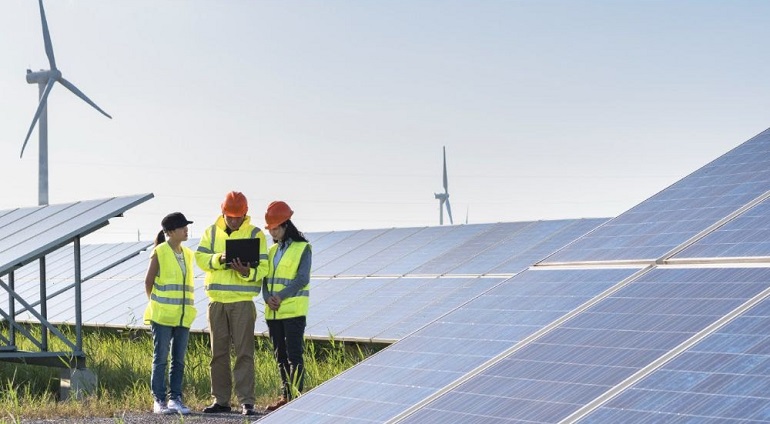
IRENA’s latest report highlights solar and wind as global cost leaders; calls for urgent grid, financing, and policy reforms to sustain momentum.
Renewables have solidified their dominance in global power generation, with 91% of new renewable energy projects in 2024 outperforming fossil fuel alternatives on cost, according to the International Renewable Energy Agency’s (IRENA) new report, Renewable Power Generation Costs in 2024.
The comprehensive study reveals that renewables are no longer just environmentally essential—they are now the most economical choice for new electricity generation worldwide.
Key Findings:
- Onshore wind was the most affordable renewable source at USD 0.034/kWh, followed by solar PV at USD 0.043/kWh.
- On average, solar PV was 41% cheaper than the lowest-cost fossil fuel options; onshore wind was 53% cheaper.
- In 2024, 582 GW of new renewable capacity was added, leading to USD 57 billion in fossil fuel cost savings.
- Total avoided fossil fuel costs from operating renewable capacity in 2024 reached up to USD 467 billion.
IRENA Director-General Francesco La Camera stated, “The cost-competitiveness of renewables is today’s reality. But to maintain this momentum, we must address geopolitical risks, trade barriers, and financing challenges—especially in the Global South.”
Financing and Grid Integration Emerging as Key Barriers
While technology advancements and economies of scale have driven down costs, the report warns of increasing barriers to renewable expansion. These include:
- Grid bottlenecks and permitting delays, particularly in G20 and developing countries.
- High financing costs, especially in capital-constrained markets such as Africa and parts of Asia and Latin America.
- Unstable policy frameworks and opaque procurement systems that discourage investment.
The report cites stark differences in financing costs: while Europe benefits from lower capital costs (3.8%), regions like Africa face rates up to 12%, significantly inflating renewable energy prices despite similar generation costs.
Technological Innovation Strengthens Business Case
Technological progress continues to improve the economics of renewables beyond generation. The cost of battery energy storage systems (BESS) has plummeted 93% since 2010, reaching USD 192/kWh for utility-scale systems in 2024. Hybrid systems integrating solar, wind, and storage, along with AI-enabled digital tools, are enhancing grid responsiveness and reliability.
However, the report underscores that digital infrastructure and modernized grids are vital for harnessing the full potential of variable renewables. Without targeted investments in these areas, many emerging economies risk being left behind in the energy transition.
Global Leaders Urge Action
UN Secretary-General António Guterres reiterated the importance of removing investment and regulatory barriers, stating, “Clean energy is smart economics. The fossil fuel age is crumbling, but governments must unleash finance and accelerate action to ensure affordable, secure power for all.”
IRENA’s report concludes that while renewables are now the most cost-effective choice for new generation, their sustained competitiveness hinges on global cooperation, transparent financing structures, and accelerated grid development.