

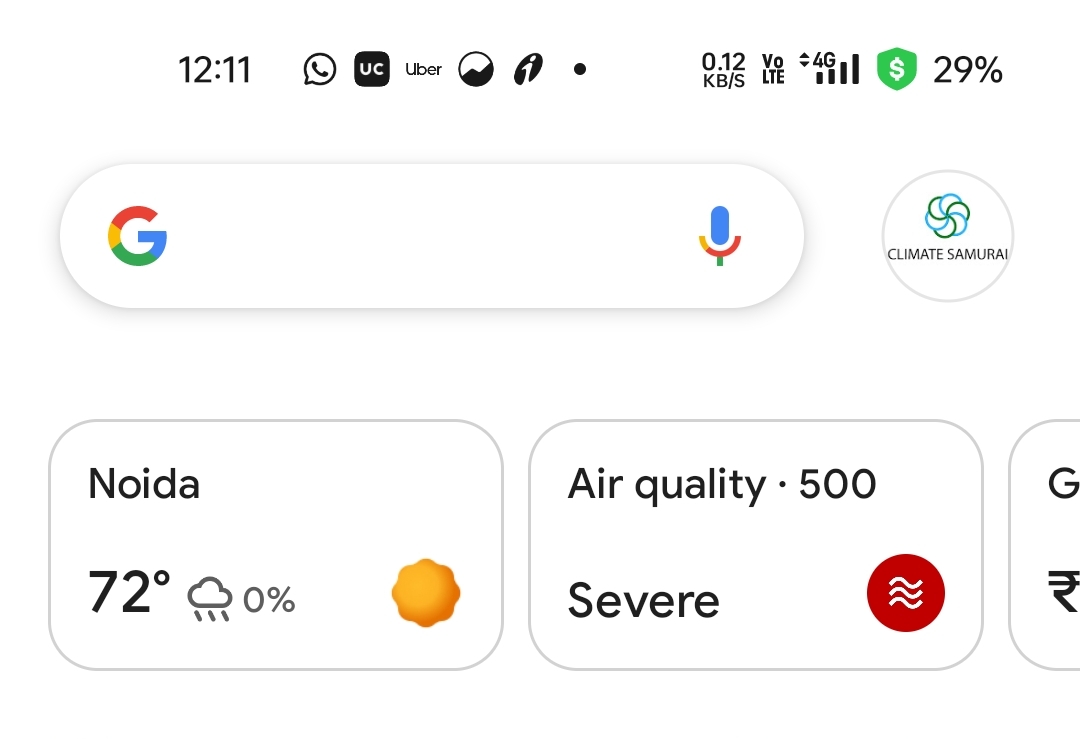
Delhi NCR’s air quality plunged back to the ‘severe’ zone on Thursday, with the Air Quality Index (AQI) touching 500 in several locations—once again choking the region under a toxic haze. The spike comes barely a day after the Commission for Air Quality Management (CAQM) revoked Stage 3 restrictions of the Graded Response Action Plan (GRAP), even though the AQI was still at a ‘very poor’ 327 at the time of the decision.
The withdrawal of curbs has allowed construction activities to resume and older diesel vehicles to return to the roads, despite the Capital clocking its 21st consecutive day of hazardous air. The move has raised serious concerns among health experts, environmental researchers, and residents who were already grappling with the prolonged pollution spell.
Decision Draws Sharp Criticism
The rollback came just a week after the Supreme Court urged the CAQM to adopt “proactive and stringent measures” to combat worsening air pollution. Forecasts had also warned that air quality would remain in the ‘very poor’ range over the coming days.
Air quality between 301–400 is categorised as ‘very poor’, a level that can cause respiratory distress in prolonged exposure—an observation echoed in the Supreme Court on Wednesday when the Chief Justice and senior advocates shared their own struggle with breathing difficulties.
Despite this, CAQM’s order offered little clarity on the reasoning behind easing restrictions. The decision appeared to hinge on marginal AQI improvement and recently updated GRAP norms issued on November 21. However, experts argue that such minimal fluctuations are not enough to justify policy relaxation.
Experts Call Move “Premature” and “Illogical”
IIT Delhi air pollution expert Prof. Mukesh Khare criticised the rollback, calling it “too early and too quick.”
Speaking to Hindustan Times he said “We know temperatures are dipping, and AQI keeps fluctuating at this time of year,” he said. “November to January are crucial months. Unless there is rainfall or a significant drop in pollution levels, such decisions should not be taken. There is hardly any difference between an AQI of 320 and 350—we cannot normalise slightly lower values.”
The move also exposed a widening gap between scientific advice, citizen expectations, and the commission’s approach. Earlier on Wednesday, the East Delhi Federation of RWAs called the existing restrictions “ineffective” and demanded even tougher measures instead of relaxations.
Citizens and Doctors Sound Alarms
Public frustration is intensifying. Former Puducherry Lieutenant Governor Dr. Kiran Bedi posted an urgent appeal to Prime Minister Narendra Modi, sharing her own experience of struggling to breathe in Delhi’s toxic air.
Meanwhile, doctors report an alarming surge in pollution-related illnesses.
Paediatrician Dr. Shishir Bhatnagar told BBC that PM2.5 exposure is hitting children and the elderly the hardest.
“These particles weaken children’s immunity because their systems are still developing,” he said. “Cases have increased tenfold in recent years. During the pollution season, respiratory complaints rise from the usual 20–30% of patients to nearly 50–70%.”
Will Relaxed Curbs Worsen the Crisis?
Thursday’s return to ‘severe’ AQI levels suggests that easing Stage 3 restrictions may worsen the situation rather than improve it. With winter setting in, low wind speeds and temperature inversions will continue to trap pollutants close to the ground.
Experts warn that without consistent, science-backed measures, the Capital may face an even longer and more toxic pollution season—raising questions about whether policy decisions are aligning with on-ground realities or underestimating the health emergency unfolding across Delhi NCR