

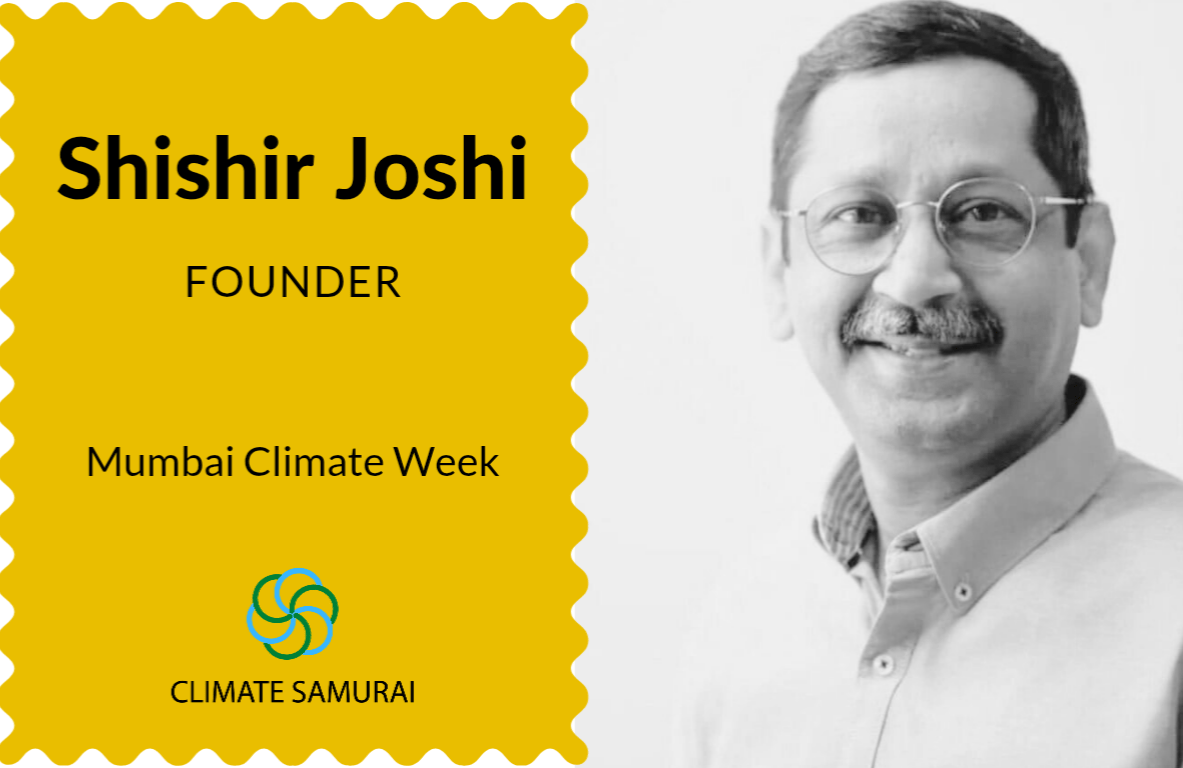
In an exclusive interview, Project Mumbai CEO and Mumbai Climate Week founder Shishir Joshi outlines how India’s first city-anchored climate platform plans to move beyond symbolism, amplify community voices, and deliver scalable solutions across food systems, energy transition, and urban resilience.
Q 1: Mumbai Climate Week positions itself as India’s first dedicated climate-action platform. What specific gaps does it aim to fill that existing summits, COP side events, or green expos have not addressed?
A: Mumbai Climate Week (MCW), to be held between February 17-19, 2026, marks India’s first platform dedicated to accelerating climate action, empowering Mumbai, India, and the Global South to develop transformative, citizen-driven climate action. The intervention aims to translate high-level global ambition into ground-level action, particularly for countries of the Global South. It reimagines critical climate solutions as interconnected, scalable innovations rooted in the complex dynamics of the Global South region and its economies. The innovation challenges are key interventions at MCW. It will feature young changemakers and early-stage, growth-ready, and sector-focused innovators from startups, civil society, academia, and the wider climate ecosystem. They will present breakthrough solutions across food systems, urban resilience, and energy transition.
While COP and other similar events focus on international negotiations and global policy, MCW is a platform emphasising actionable, scalable initiatives for the Global South. It fosters collaboration among diverse stakeholders, including communities, governments, corporates, and civil society, through innovative formats such as plenary sessions, innovation showcases, and policy dialogues.
Likewise, Green expos focus largely on technological or commercial solutions while MCW purports to be a city-scale, citizen-anchored platform that deliberates and even prescribes community-led and policy-friendly actionable interventions.
MCW will bring climate conversations closer to where impacts are already unfolding—cities, neighbourhoods, informal settlements and everyday livelihoods. It attempts to complement global or national forums by translating climate ambition into grounded action. The programme architecture is designed to unearth scalable solutions within the boundaries of existing ecosystems and connect them to suitable institutions and communities. The agenda is structured around three deeply interconnected pillars—Food Systems, Energy Transition, and Urban Resilience—with each pillar explored through plenary sessions, policy-to-practice dialogues, innovation showcases, and implementation-focused panels.
Q 2: The theme “Where Hope Meets Action” is compelling, but climate events often stop at intent. What hard, measurable outcomes should India expect by the end of MCW 2026?
A: We believe that food systems, energy transition and urban resilience are ripe areas for constructive partnerships. We are confident that we will be able to develop implementation pathways that can create positive change. The conversations at MCW will be focused on identifying actionable solutions focused on measurable direction and continuity. Sessions such as “From Policy to Practice: Advancing 24×7 Renewable Energy for India and the Global South,” “DRE for Development,” and “Accelerating Sub-national Climate Action” are explicitly designed to bridge the gap between policy frameworks and on-ground execution.
MCW’s success lies in delivering solutions that can be scaled up to catalyse a citizen-led and policy-supported momentum towards constructive climate action.
Q 3: As a citizen-led movement, how will MCW ensure that community voices meaningfully shape the agenda, rather than being overshadowed by corporates, consultants and policymakers?
A: We, at Project Mumbai,have been actively involved in civic work across the city. We have consistently integrated communities in our interventions. MCW will carry that philosophy across the event. The interactions and engagements during the event will centre around pressing subjects, such as extreme heat and outdoor work, healthy air zones, food access, urban cooling, and decentralised energy. The engagements will cite and heavily rely on lived experiences as context and the problem statement. Renewable power, natural cooling systems, clean air action, food systems transformation, urban living, community actions, etc., will be recurring themes throughout the event.
We plan to integrate community participation across programming formats by including schools, colleges, NSS groups, neighbourhood initiatives and citizen-led innovations in active discussions. Corporates and policymakers will participate with the understanding that they would be engaging with citizen realities, not speaking over them. The presence of diverse stakeholders on the same stage will stoke conversations between corporates, communities and considerations, with the intent to develop win-win solutions.
Q 4: How does MCW plan to avoid becoming a one-time showcase event and instead evolve into a long-term climate action institution?
A: Rather thanan annual spectacle, MCW was conceived as a sustained climate action platform that facilitates engagements and encourages development of solutions.
This is reflected in how MCW is structured—through year-round partnerships, pilot initiatives, follow-up mechanisms and continued citizen engagement. The main ‘Hub’ event is complemented by a series of ‘spoke’ activities that take place in the run-up to, and during, Mumbai Climate Week. Success will be judged by what continues after the event: adopted solutions, implemented collaborations, and catalysing learning into future action. MCW endeavours to build momentum towards positive and constructive climate action, especially in the Global South, long after the applause ends.
Q 5: MCW claims to amplify the voice of the Global South. What makes this platform genuinely different from global climate forums where developing countries are present but often not influential?
A: The Global South faces disproportionate climate impacts despite contributing less to emissions. MCW amplifies voices, solutions, and collaborations from these regions, fostering resilience through shared knowledge and scalable initiatives. The agenda is designed around Global South realities—high population density, informality, climate vulnerability, infrastructure gaps and limited fiscal buffers. The issues presented at the sessions will portray realities from the Global South’s context and try to frame solutions for the existing challenges. MCW will see engagement in the subjects of improving liveability of Indian cities, delivering heat resilience, creating robust food systems, etc., which are challenges across the Global South region.
MCW aims to position Mumbai as a bridge for Global South leadership in global climate discourse, particularly ahead of events like COP30. Mumbai is positioned not as a showcase city, but as a climate frontline. We aim to unearth pioneering solutions that will work for most cities across Asia, Africa and Latin America.
Q 6: Mumbai is among the world’s most climate-vulnerable megacities. How will MCW translate discussions into real solutions for informal settlements, coastal communities and the urban poor?
A: MCW acknowledges that climate vulnerability is uneven. Informal settlements, coastal communities and low-income populations experience climate stress first and most intensely. That is why themes such as heat resilience, cooling, food access, coastal protection and energy security are central agenda items. Sessions on extreme heat and outdoor work, healthy air zones, and nature-based urban cooling explicitly prioritise worker safety, public health, and community resilience.
Solutions presented at MCW will be assessed on whether they function in resource-constrained settings. MCW will give more weightage to interventions that improve resilience for the urban poor. Meaningful climate action, according to us, has to be based on community-level solutions that address standards of living, especially of the disadvantaged urban resident. The insistence on relevance helps ensure that discussions lead toward solutions that can actually be deployed where they are most needed.
Q 7: How do you balance global relevance with hyper-local realities like flooding, air pollution and infrastructure inequities?
A: MCW’s primary objective is to identify and scale high-impact initiatives and solutions that address climate change in priority areas, fostering measurable outcomes for communities in the Global South. These initiatives and solutions are evaluated through the lenses of ‘Justice, Innovation, And Funding’, championing climate adaptation and resilience alongside mitigation practices. By addressing the trade-offs between development indicators and climate action, MCW tackles the unique challenges faced by developing nations.
Cities in developing nations are where global climate change becomes tangible and visible. Mumbai’s challenges—flooding, heat stress, air pollution and infrastructure strain—are not unique; they mirror conditions across the Global South. By anchoring discussions in hyper-local realities, MCW actually strengthens global relevance.
MCW will act as a living laboratory, ensuring conversations remain rooted in experience while outcomes remain transferable.
Q 8: The three pillars—Food Systems, Energy Transition and Urban Resilience—are deeply interconnected. How will MCW prevent siloed conversations and ensure accountability from thematic partners?
A: The interconnected themes were carefully selected because they represent areas where development priorities in the Global South overlap most significantly with climate action needs. They allow for deep exploration of system-wide solutions that can be scaled for real impact, addressing critical challenges, including population density, resource access, and urban vulnerabilities.
By focusing narrowly, MCW aims to drive meaningful progress rather than superficial coverage.Despite the focus, MCW desists from creating thematic silos and focuses on nurturing systems-based thinking. Interventions and conversations are intentionally designed to cut across sectors—for example, examining how energy choices affect water systems or how food security links to urban resilience.
Thematic partners are engaged with clear expectations: participation goes beyond thought leadership into tangible contributions such as pilots, collaborations or policy pathways. Accountability comes from making these commitments visible and tracking what happens next.
Q 9: What criteria will define “high-impact” innovations at MCW?
A: MCWvalues innovations that involve novel approaches to solve existing hurdles or barriers in climate action. We firmly believe that solutions must introduce creative methods, technologies, or strategies to address challenges in food systems, energy transition, and urban resilience effectively.
High impact is defined through a balanced lens that includes climate benefit, social equity, scalability and real-world utility in Global South conditions. For instance, an innovation can only be considered as effective if it meets community expectations. An innovation that falls short of the purpose may be unsuitable despite attracting capital. Impact will be measured not by novelty, but by usefulness at meeting its intended consequences. Additionally, rather than the linear metric of numbers, we provide more weightage to how deeper and broader does the solution seep into society.
Q 10: With the Government of Maharashtra and BMC as key partners, how will MCW ensure constructive pressure rather than ceremonial participation?
A: The Government of Maharashtra supports MCW by providing strategic guidance, policy alignment, and resources to ensure the event’s success. It facilitates coordination with state-level climate initiatives and promotes Mumbai as a leader in urban climate action. Likewise, the Brihanmumbai Municipal Corporation (BMC) collaborates with MCW to align and support core and peripheral event activities around the city during and prior to MCW.
MCW’s approach to accountability is rooted in transparency rather than confrontation. By placing government agencies, experts, innovators and citizens in the same public forum, issues and solutions are discussed openly and visibly. Policy-led plenaries, sub-national climate action discussions, and sectoral dialogues are structured to move beyond symbolism and towards shared problem-solving. This openness creates its own form of constructive pressure, encouraging movement beyond symbolism toward action.
Q 11: Corporate participation often raises concerns about greenwashing. How is MCW addressing this risk?
A: MCW operates in public view, with transparent partnerships and a focus on solutions beyond branding. Participation is linked to engagement and follow-through, and MCW is exploring mechanisms to track post-event action. Credibility, for MCW, is built through effectivity and utility, rather than mere numbers and data.
Q 12: Youth engagement is highlighted through YuWaah and NSS. What real decision-making power will young people have?
A: The Youth Green Innovation Challenge is a dedicated platform for young people aged 16-24 to develop climate solutions. Participants can propose innovations across MCW’s three core themes—Food Systems, Energy Transition, and Urban Resilience—and access mentoring, visibility, and a platform to showcase their ideas at MCW’s event in February. Young changemakers can apply with concepts, school or college projects, community-led initiatives, prototypes, or pilots that demonstrate climate relevance and potential impact in India and the Global South. Mentors and jury members include youth leaders, climate practitioners, educators, government representatives, UNICEF YuWaah representatives, and industry experts with experience in youth engagement, climate solutions, and Global South contexts.
Through the Youth Green Innovation Challenge, MCW endeavours to become a platform for emerging voices to shape practical, creative, and community-driven climate solutions. We plan to create an enabling atmosphere where young changemakers can actively contribute to programme design, community-level action and innovation dialogue. The objective is to build informed, decision-capable climate leaders who can shape choices over time.
Q 13: Will MCW release a post-event public report detailing outcomes, failures and next steps?
A: No Comments
Q 14: Finally, how do you envision MCW’s role in shaping India’s climate narrative ahead of future COPs and global negotiations?
A: Mumbai remains one of the Global South’s most dynamic mega cities. A financial powerhouse, it can exemplify and present solutions that can be replicated and emulated nationwide. Through MCW, we aim to create a strong presence for India at global climate forums, positioning it as a leading voice from the Global South. We endeavour to shift India’s climate narrative from targets to lived impact, and from compliance to leadership. By proposing citizen-led and scalable solutions that are rooted in justice, MCW will strengthen India’s voice globally through example.