

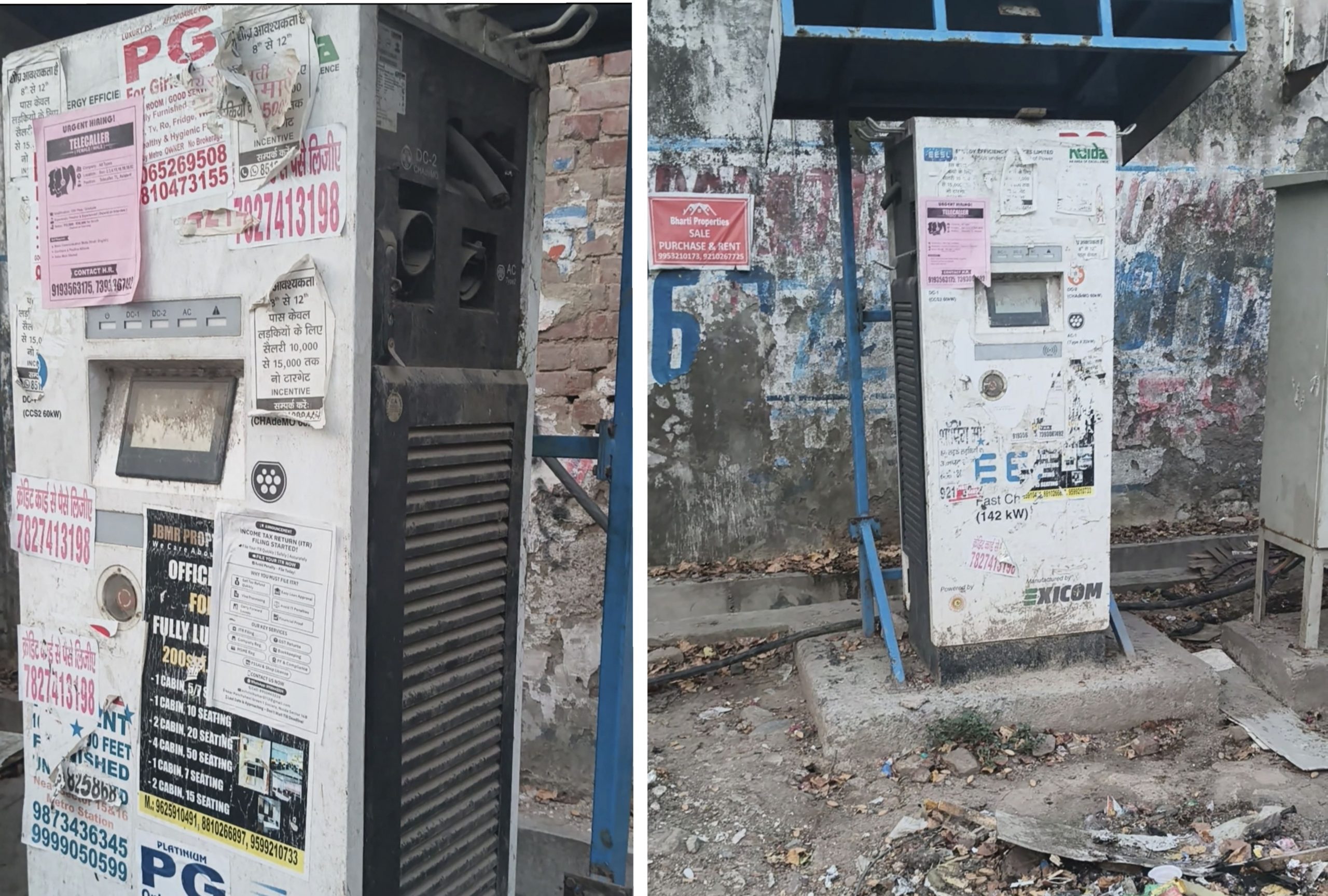
Non-functional charging points raise serious questions on accountability, public spending, and the true impact of India’s green mobility push
Every year, as Earth Day arrives, timelines flood with announcements—trees planted, sustainability drives launched, and electric vehicle charging stations installed. Corporates celebrate impact, governments highlight milestones, and institutions showcase their green credentials.
But a question continues to linger: what happens after the headlines fade?
At Climate Samurai, we have tracked these narratives since 2017. From “planted 100 trees” to “installed 200 EV charging stations,” the announcements are consistent. What remains inconsistent is accountability.
To understand the ground reality, we stepped out—away from press releases and into the streets.
A Visit That Raises More Questions Than Answers
In Noida Sector 3, near the Sector 16 Metro Station, we found not one—but four EV charging stations in close proximity.
None of them were functional.
These installations, likely funded through public money, corporate CSR budgets, or public-private partnerships, now stand as idle infrastructure. Their purpose—to accelerate the transition to clean mobility and reduce urban pollution—remains unfulfilled.
The intent behind such projects is rarely in doubt. The execution, however, tells a different story.
Numbers vs Reality
In mid-2025, Nitin Gadkari announced that over 4,500 public EV charging stations had been installed across India’s highways, covering more than 146,000 km. By December 2024, the country reportedly had over 25,000 public charging stations.
On paper, this is progress. On the ground, it demands verification.
If even a fraction of these stations are non-functional, the implications are serious—not just for India’s EV ambitions, but for public trust.
Questions We Cannot Ignore
Why were these stations installed if they were not going to be maintained?
Who is responsible for their upkeep?
Who audits their functionality after installation?
Are these projects driven by long-term planning—or short-term visibility?
Most importantly: are we building infrastructure, or just narratives?
Beyond Celebration, Towards Responsibility
Environmental action cannot be reduced to annual observances or PR milestones. If sustainability is to be meaningful, it must be measurable, maintained, and monitored.
Because a non-functional charging station does not just fail infrastructure—it fails intent.
And intent, without accountability, changes nothing.
A Call for Accountability
This is no longer just a policy issue—it is a citizen’s concern.
If you come across a non-functional EV charging station:
- Take a picture or video
- Share it on social media
- Tag the company responsible or the concerned state authority
These projects often involve multiple stakeholders, and many decision-makers may never revisit the sites once they are inaugurated. Public documentation can bridge that gap.
Transparency does not end at installation—it begins there.