

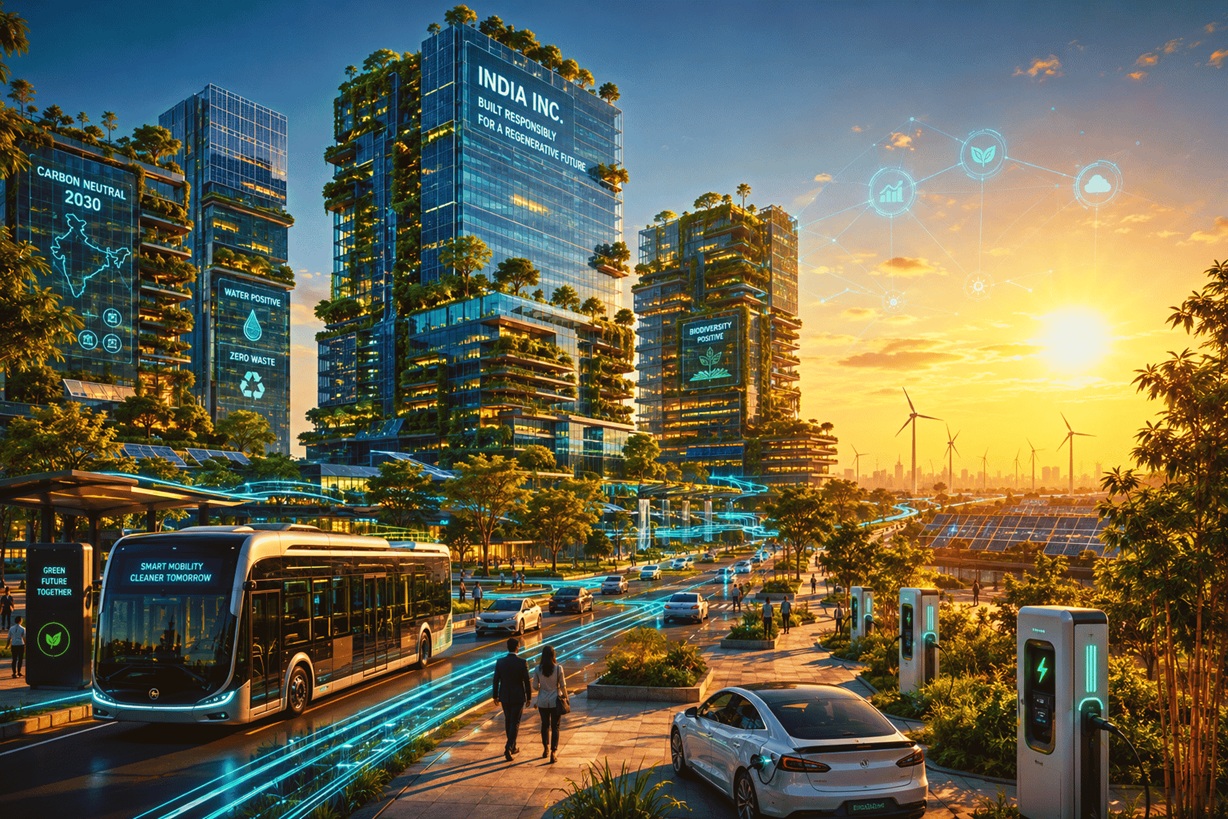
The 270 GW Wake-Up Call: Navigating India’s Structural Climate Shift
The Structural Climate Shift
As India positions itself at a critical macroeconomic and structural inflection point, the corporate dialogue surrounding climate action has permanently transitioned from passive compliance to hyper-active, scalable execution. World Environment Day 2026, themed “Inspired by Nature, For Climate. For Our Future,” arrives at a definitive moment.
The subcontinent is no longer dealing with isolated episodes of extreme weather, but rather a permanent structural climate shift that actively reshapes how cities are planned, energy is consumed, and vulnerable communities experience daily life.
The operational indicators are impossible to ignore. India’s recent peak power demand pierced through an unprecedented 270 GW ceiling during the summer. This surge offers an early, sobering signal of the immense infrastructure strain ahead, particularly given that household air-conditioning penetration remains relatively low.
The fundamental challenge for India Inc. is no longer merely reacting to heatwaves, floods, or resource stresses after they unfold, but building the intelligence layers, infrastructure resilience, and domestic capability to anticipate and adapt before risks turn into crises.
The Vanguard of Energy: Scaling Clean Generation and Grid Resilience
At the absolute heart of India’s decarbonization crusade is its phenomenal transition toward green energy. The nation is swiftly advancing toward its ambitious target of 500 GW of non-fossil fuel capacity by 2030, with roughly half of its current installed capacity already coming from non-fossil sources.
Global energy giants and domestic manufacturing powerhouses are working in tandem to establish a highly reliable, flexible, and entirely self-reliant power ecosystem.
“World Environment Day is a moment to reflect on the close link between energy and the environment. As demand for electricity continues to grow, our responsibility is clear; not just to produce more energy, but to do so in a way that is sustainable and future ready. Renewable energy is at the heart of this shift, helping reduce emissions, preserve natural resources, and strengthen long-term resilience. India has made significant progress, with around half of its installed capacity now coming from non-fossil sources and a clear pathway towards its 500 GW ambition. The focus ahead must be on ensuring this clean energy is reliable and flexible enabled by storage, hybrid solutions, and smarter energy management. At ENGIE, we are committed to playing our part in this transition” — Amit Jain, CEO & Country Manager India & MD Renewables & Batteries SEA, ENGIE
This massive capacity addition demands an equally robust domestic manufacturing infrastructure. India’s journey from a modest 2.3 GW of solar module capacity in 2014 to a towering 172 GW today showcases the immense power of localized production under the Make in India and Aatmanirbhar Bharat banner.
The focus has rapidly converged on building a complete domestic manufacturing ecosystem that supports energy independence and strengthens India’s global clean energy positioning.
“As India moves towards its target of 500 GW of non-fossil fuel capacity by 2030, World Environment Day reminds us that sustainability is not just an environmental priority, it is central to the nation’s economic growth and development. India’s solar manufacturing journey, from 2.3 GW of module capacity in 2014 to 172 GW today, reflects the strength of the Make in India and Aatmanirbhar Bharat vision. At Goldi Solar, we are proud to be a part of this transformation, having scaled our manufacturing capacity from 3 GW to 15.2 GW in just 14 months, an achievement unmatched in the Indian renewable energy industry” — Ishver Dholakiya, Founder & Managing Director, Goldi Solar
Beyond scaling raw capacity, the current operational imperative revolves around maximizing the efficiency, asset longevity, and technical robustness of existing clean energy installations. India’s installed renewable energy capacity now crosses 279 GW (including large hydro), ranking third globally.
To sustain this milestone, project decisions must focus on extracting higher performance and optimization throughout their operational lifecycles.
“Sustainable progress is not just about building more; it is about making what we build work better for the future. As we continue to expand RE capacity, it is equally important to ensure that existing assets operate efficiently and reliably over the long term. The true value of a RE project lies in its ability to consistently generate maximum clean energy throughout its lifecycle – more MWh of Energy per MW of Power installed!” — Praveen Kakulte, Founder & CEO, POWERCON Group
“Environmental sustainability is no longer a standalone objective; it is increasingly intertwined with economic resilience, energy security, and long-term value creation. As governments and industries accelerate investment in clean energy infrastructure, the emphasis must be ensuring that projects are technically robust, financially sustainable, and capable of delivering lasting outcomes.” — Arif Aga, Director, SgurrEnergy
Simultaneously, alternative decentralized energy options such as agricultural and organic biomass residues are proving instrumental in fortifying rural economies while adding localized, practical, and scalable baseload power to the country’s grid.
“At Ankur Scientific, we have always believed in the potential of biomass as a renewable source of energy that can create value from agricultural and organic residues while supporting local communities. This World Environment Day, we reaffirm our commitment to developing clean energy solutions that contribute to energy security, support rural economies, and help reduce environmental impact,” — Ankur Jain, Managing Director, Ankur Scientific
Hard-to-Abate Sectors & The Built Environment: Closing the Circular Loop
Heavy manufacturing industries and the real estate construction sector are traditionally categorized as hard-to-abate segments. Today, however, they are leading some of the most advanced circular economy interventions.
Given that the built environment dictates nearly 37% of global energy-related carbon emissions, and with industry estimates suggesting that nearly 70% of the urban infrastructure India will require by 2047 is yet to be built, the strategic choices executed by modern heavy industry will irrevocably dictate the nation’s climate resilience.
The Indian cement sector has aggressively stepped forward to align with the government’s strict Net-Zero carbon mitigation roadmaps.
Leaders are spearheading deep decarbonization through massive improvements in energy efficiencies, co-processing multi-sectoral industrial waste streams, and exploring advanced Carbon Capture, Utilisation, and Storage (CCUS) technologies.
“The Indian Cement Industry is aligned to the Government’s commitments on carbon mitigation and is accelerating the adoption of cleaner technologies, resource efficiency and circular economy practices while actively exploring the potential of Carbon Capture, Utilisation and Storage (CCUS) as a critical pathway for deep decarbonisation. One of the most powerful ideas in sustainability is that waste from one sector can become a resource for another. By coprocessing industrial by-products and waste streams that would otherwise require disposal, the Indian Cement Industry helps close material loops, conserve natural resources and reduce the environmental footprint of multiple sectors simultaneously,” — Parth Jindal, President, Cement Manufacturers’ Association (CMA) & MD, JSW Cement
“Sustainability in the built environment cannot be measured by emissions alone. It is equally about how efficiently we use resources, how effectively we minimise waste and how responsibly we create the infrastructure that will serve future generations. As a sector that forms the foundation of India’s development, the Indian Cement Industry has a responsibility to balance growth with environmental stewardship,” — Dr. Raghavpat Singhania, Vice President, CMA & MD, JK Cement Limited
This philosophy is filtering directly into real estate development, where the emphasis has structurally evolved beyond superficial aesthetics toward comprehensive, performance-driven green design, energy-efficient building façades, low-carbon materials, and water-sensitive urban planning.
“World Environment Day serves as an important reminder that sustainability in the built environment is no longer a niche ambition but both an environmental and economic necessity. Buildings and construction today account for a significant share of global carbon emissions, and with India’s urban footprint expanding rapidly, the choices developers make now will play a defining role in shaping the country’s climate resilience for decades to come. Industry estimates suggest that nearly 70% of the infrastructure India will require by 2047 is yet to be built, making sustainable construction one of the most important responsibilities for the sector today., — Vishal Vincent Tony, Managing Director, Aratt Developers & Founder, Ayatana Hospitalities
“True sustainability is no longer an afterthought or a mere compliance exercise. It is fast becoming the very foundation of progress by guiding our choice of materials, redefining energy efficiency, inspiring innovative design, and ensuring that every structure exists in harmony with its natural surroundings, not at their expense,” — Minal Srinivasan, Managing Director, Kesari Infrabuild Pvt. Ltd
Academic leaders underscore that this structural shift requires a complete reimagining of design pedagogy, instilling a deep environmental consciousness within the next generation of urban architects long before a building is constructed.
“For architects, designers, and the students who will shape the built environment of tomorrow, this responsibility begins long before a building is constructed. It starts with the ideas we develop, the materials we choose, and the way we think about the relationship between people and their environment. At VESCOA, we encourage our students to look beyond aesthetics and understand the broader impact of their work.” — Dr. Prof. Anand Achari, Principal, VES College of Architecture
The Smart Mobility Revolution: Decarbonizing the Indian Roadway
Transportation remains a highly critical combat zone for climate action, single-handedly generating nearly 15% of global greenhouse gas emissions. In response, India’s automotive titans and electric mobility disruptors are scaling integrated ecosystems to transform how people, goods, and commercial enterprises move forward safely and responsibly.
Global automotive flagbearers operating in India are aggressively shifting their massive industrial footprints toward absolute carbon neutrality. Guided by global mandates like the Regenerate+ strategy and the goTOzero mission, they aim to achieve net carbon neutrality by 2050 while drastically cutting plant operations’ footprints and shifting to 100% renewable rooftop capacities.
“At Škoda Auto Volkswagen India, sustainability is not a checkbox or a distant ambition. It is the driving force that shapes how we grow, how we innovate, and how we care for the world around us. Guided by Volkswagen Group’s Regenerate+ strategy and the goTOzero mission, we have set our defining goal, aiming to become carbon neutrality by 2050… This vision is already taking root in tangible ways – from reducing our plant operations’ carbon footprint by nearly half compared to the 2018 baseline, to achieving Zero Waste to Landfill and Zero Liquid Discharge, to harnessing 19.5 MWp of rooftop solar capacity across our Chakan and Chhatrapati Sambhajinagar facilities,” — Piyush Arora, Managing Director & CEO, Škoda Auto Volkswagen India
Simultaneously, the meteoric expansion of the domestic electric vehicle (EV) sector—sparked by annual registrations crossing a historic 2 million units in 2025—is being driven forward by crucial breakthroughs in smarter infrastructure, accessible battery-swapping technology, and highly practical micro-mobility engineering.
“World Environment Day is a reminder that building a greener future requires both cleaner technologies and smarter energy infrastructure. At Battery Smart, we are enabling this transition by making electric mobility more accessible, affordable, and inclusive through innovative battery solutions. Our network has powered more than 3.6 billion emission-free kilometres and helped avoid over 260,000 tonnes of CO₂e emissions till date,” — Pulkit Khurana, Co-founder & CEO, Battery Smart
“Transportation accounts for nearly 15% of global greenhouse gas emissions, making it a critical area for climate action. As our mobility needs continue to grow, it is important that we embrace cleaner and more sustainable ways to travel. Electric vehicles are helping accelerate that change. In India, EV registrations crossed 2 million units in 2025, showing that more people are embracing cleaner mobility options,” — Jhumarmal Tunwal, Promoter, Chairman & Managing Director, Tunwal E-Motors Limited
“The future of mobility will not be defined by speed or convenience but by how responsibly it moves people, businesses and communities forward. At Emobi, we believe the transition to electric mobility is not just about replacing fuel-powered vehicles with electric ones but creating an ecosystem that makes sustainable transportation accessible, reliable, and scalable,” — Bharath Krishna Rao, CEO & Co-founder, Emobi
The Digital Frontier & Smart AI: Cooling the Engines of Progress
As India rapidly accelerates its domestic artificial intelligence (AI) and digital governance ambitions, an entirely fresh environmental challenge has emerged: the gargantuan power and water requirements of hyper-scale data centres. Mumbai alone accounts for more than half of India’s current capacity, with the nationwide committed pipeline rapidly racing toward 3 GW. The infrastructure choices made today regarding digital architectures will echo for several decades.
“India is at a defining inflection point. We are building the digital infrastructure that will power the next decade of economic growth, and the decisions we make today about how we design, build, and operate data centres will echo for decades. Mumbai alone already accounts for more than half of India’s data centre capacity, with total committed capacity across the country heading toward 3GW. That scale brings responsibility. At Colt DCS, we believe sustainable design is the credible path to ambition,” — Nikhil Parate, Head of Energy and Sustainability, Colt DCS India
To prevent technological advancement from occurring at the direct cost of the environment, infrastructure architects are deploying cutting-edge liquid immersion cooling and domain-specific, energy-frugal AI systems designed to operate with minimal carbon overheads.
“Nature has always been the most efficient engineer. It cools, conserves, and regenerates without waste. As India scales its AI ambitions, the industry must ensure that technological progress does not come at the expense of the environment. The AI revolution requires immense computing power, making it imperative for data centres and digital infrastructure providers to adopt sustainable solutions such as liquid cooling and clean energy,” — Narendra Sen, Founder & CEO, RackBank and NeevCloud
This urgent optimization of cooling extends symmetrically to consumer spaces. As Indian summers grow increasingly harsh, innovative air-conditioning startups are re-engineering thermodynamics to deliver heavy-duty comfort without adding unsustainable pressure to the power grid.
“World Environment Day is a reminder that the way we cool our homes today will shape the climate we live in tomorrow. As Indian summers become longer and harsher, air-conditioning is no longer a luxury. It is becoming a necessity. But the answer cannot be more cooling at any cost. The real responsibility is to build cooling that is powerful, efficient and designed for the climate realities of India,” — Ashish Goel, CEO & Co-founder, Optimist
Unleashing Strategic Capital for a Regenerative Horizon
The historic friction between unbridled capital generation and environmental conservation has officially shattered. Modern economic frameworks acknowledge that sustainable long-term growth is fundamentally impossible on a planet that cannot sustain biological life. This realization has unlocked a massive wave of venture capital aimed squarely at de-risking early-stage climate technologies and opening up institutional capital flow.
“Historically, capitalism and environmental stewardship were viewed as opposing forces, with capital generation often working against the environment by extracting more than it replenishes. However, that narrative is breaking as the world realizes that we do not exist independently of the environment, and economic growth is not possible on a planet that cannot sustain life. This is where investing in climate-tech becomes imperative… Venture capital plays a catalytic role in supporting innovative environmental solutions by de-risking technology development and unlocking these markets for mainstream institutional capital,” — Bharti Singhla, Principal, Momentum Capital
Ultimately, as academic and industrial leaders conclude, true climate resilience will not emerge through isolated technological breakthroughs or basic compliance certificates alone. It demands a holistic, interdisciplinary collaboration that blends deep human imagination with the time-tested, cyclical wisdom of natural ecosystems.
“Nature is not merely a resource to be protected; it is a source of inspiration for how we design, build and live. The theme of World Environment Day 2026, ‘Inspired by Nature, For Climate. For Our Future,’ reminds us that many of the solutions to climate change already exist in the intelligence of natural systems like resilience, adaptability, circularity and regeneration… At Anant National University, we believe that addressing climate change requires more than technological advancement. It demands imagination, interdisciplinary collaboration and a deep understanding of the relationship between people, places and the planet,” — Dr. Sanjeev Vidyarthi, Provost, Anant National University
“The conversation around climate change has moved from awareness to action. With infrastructure development continuing to expand, it is important that environmental considerations remain part of how projects are planned and executed… At Jyoti Structures, we are committed to responsible practices across our operations, with a focus on resource efficiency, environmental compliance, and continuous improvement,” — Vandana Kudalkar, Senior VP – QHSE, Jyoti Structures Limited
By bridging the gap between raw capital, industrial accountability, and nature-inspired design, India’s corporate pioneers are decisively proving that economic prosperity and the preservation of the planet are not competing objectives—they are one and the same.