

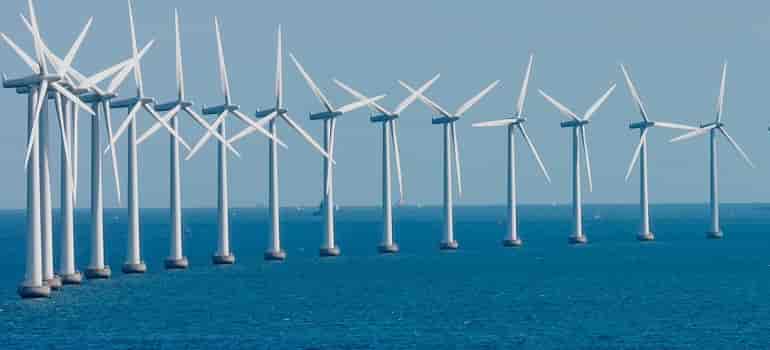
Despite a 26% dip in new installations, the offshore wind sector is projected to add 350 GW by 2034, with China and Europe leading the charge while emerging markets gain momentum.
In 2024, the global offshore wind sector added 8 GW of new capacity, marking a 26% decline compared to 2023, yet still ranking as the fourth-highest year on record for offshore wind deployment. According to the latest industry report, total global offshore wind installations have now reached 83.2 GW, accounting for 7.3% of total global wind capacity.
Over the past decade, the offshore wind market has maintained an average annual growth rate of 10%. China led new installations for the seventh consecutive year, followed by the United Kingdom, Taiwan (China), Germany, and France. These top five markets contributed 94% of new capacity in 2024.
China remains the undisputed global leader in cumulative offshore wind installations, holding 50% of the global market share, with the UK in second place. Germany, the Netherlands, and Taiwan (China) complete the top five. Notably, Denmark, a pioneer in offshore wind, fell out of the top five for the first time.
Floating wind capacity also saw progress, with 278 MW net capacity installed globally by the end of 2024. Norway led floating wind additions with 101 MW, followed by the UK (78 MW), China (40 MW), France (27 MW), Portugal (25 MW), Japan (5 MW), and Spain (2 MW).
Looking ahead, the report forecasts a compound annual growth rate (CAGR) of 21% for offshore wind over the next decade (2025–2034). This trajectory is expected to add 350 GW, bringing total offshore capacity to 441 GW by 2034. Annual installations are set to double in 2025, triple by 2027, and surpass 30 GW by 2030, ultimately reaching 55 GW in 2034.
While China and Europe will continue to lead in capacity additions, their combined global market share is projected to decline from current levels to 89% in 2029 and 84% by 2034, as offshore wind adoption accelerates in APAC, North America, and Latin America.