

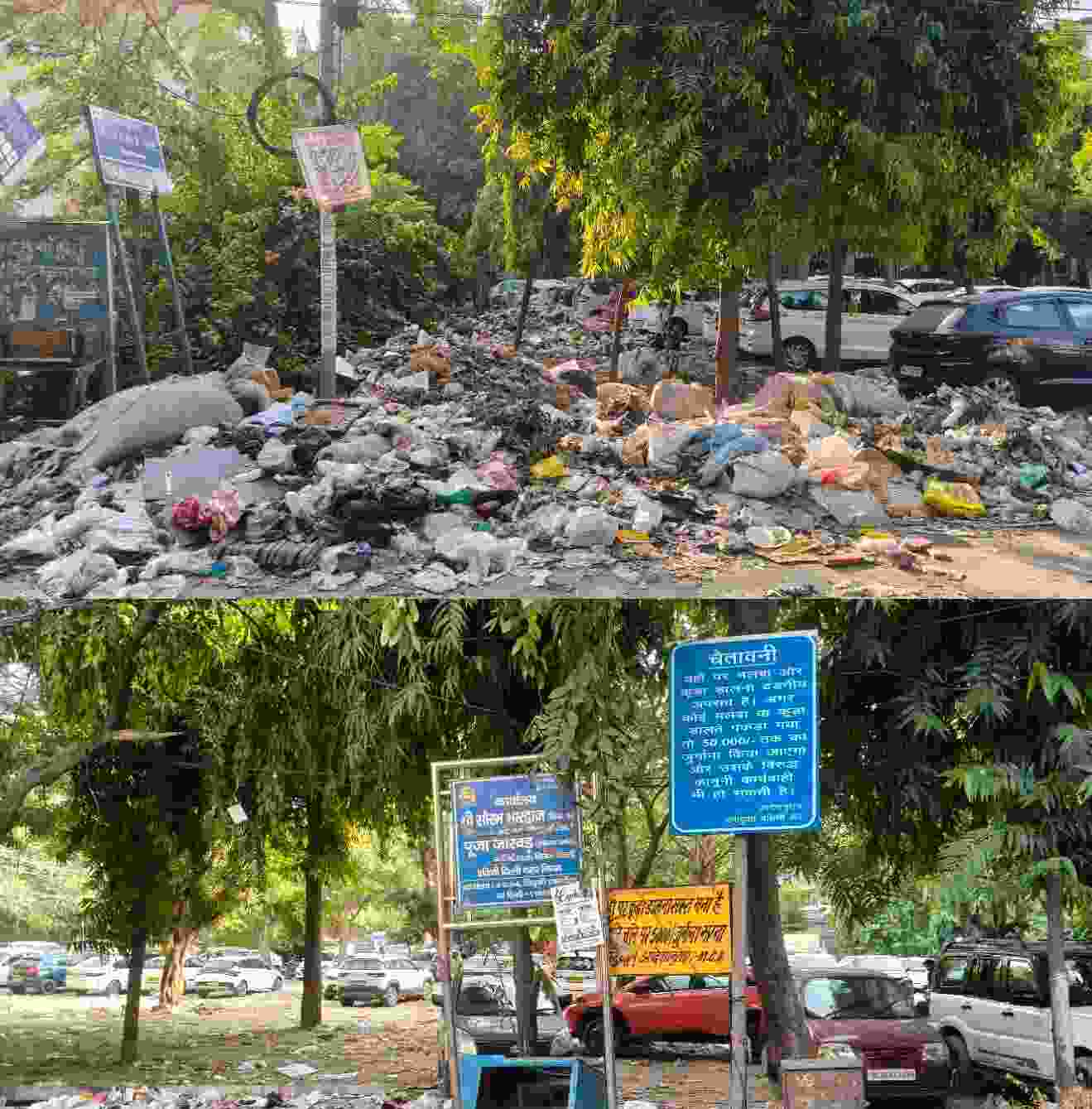
Climate Samurai Ground Report: As Delhi government showcases shrinking landfill mountains and new waste-processing plants, a children’s park in upscale R Block, Malviya Nagar, has turned into a sprawling garbage dump—with warning boards threatening fines of up to ₹50,000.
Delhi’s garbage mountains may be getting smaller at Okhla, Ghazipur and Bhalswa. But step away from the landfill sites and the city’s waste crisis tells a very different story.
A recent Climate Samurai ground report from R Block, Malviya Nagar, near Select Citywalk, found a large open area that appears to have once served as a children’s park now overwhelmed by heaps of mixed garbage.
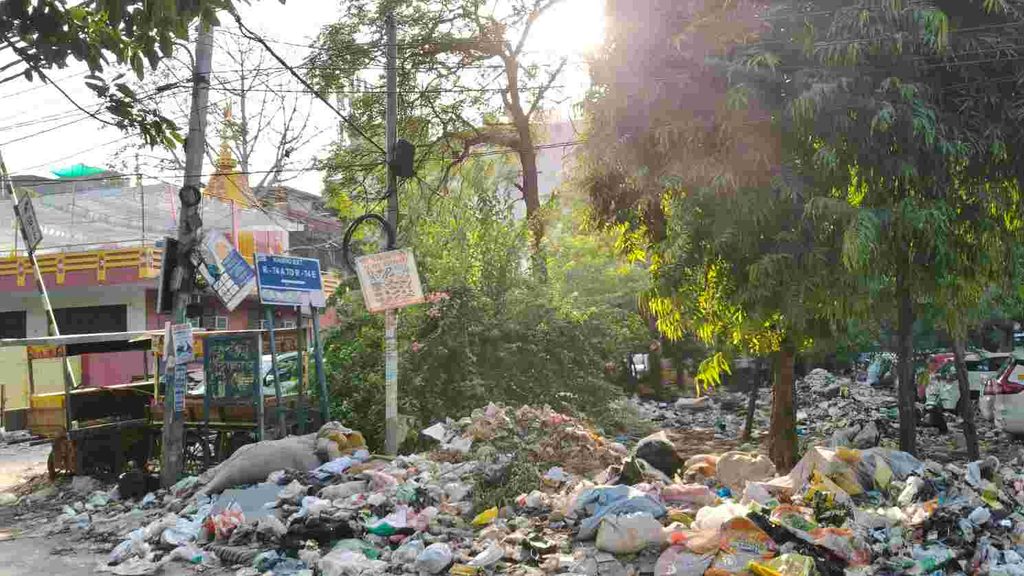
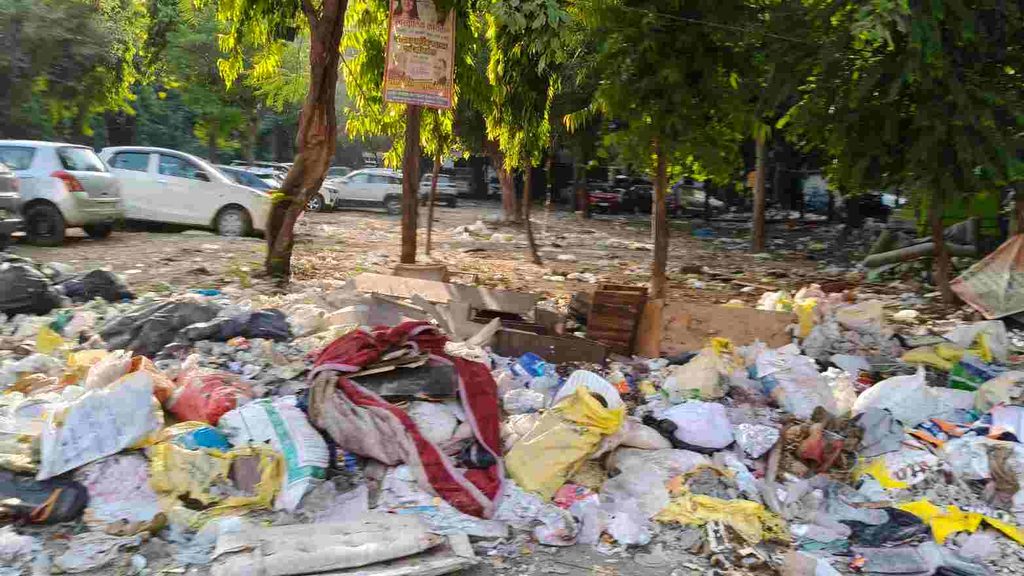
The photographs taken at the location show plastic bags, food packaging, household waste, discarded textiles, construction debris and other refuse spread across the ground. The waste sits beneath trees, alongside parked vehicles and close to residential properties.
Flies and the pungent smell of decomposing waste are part of the scene.
And there is an especially uncomfortable detail: a municipal warning board at the site explicitly says dumping garbage and debris is prohibited and can attract a fine of up to ₹50,000, besides legal action. Yet the garbage keeps coming.
Delhi’s landfill success story meets a very different ground reality
The Climate Samurai ground report comes days after Delhi Chief Minister Rekha Gupta highlighted the government’s progress in tackling the city’s legacy waste.
Gupta said nearly 100 acres had been reclaimed across Okhla, Bhalswa and Ghazipur landfill sites over the past 18 months, with 217.17 lakh metric tonnes of waste reportedly disposed of. She also said almost all waste at Okhla that existed before January 2025 had been processed. (ThePrint)
The government has simultaneously announced new processing facilities at Okhla, Singhola and Ghazipur, adding a proposed 2,900 tonnes per day of fresh-waste processing capacity. (The Indian Express)
Gupta has stressed that the objective is not merely to clear old landfill waste but also to ensure that fresh waste does not form new garbage mountains. (The Tribune)
But that promise raises an obvious question:
If fresh waste is being scientifically processed before it can form new garbage mountains, why is so much of it still visible on Delhi’s streets and neighbourhoods?
A separate investigation published by ThePrint on October 8 reported a 5,500-tonne daily gap between Delhi’s waste generation and processing capacity. It also reported more than 1.9 lakh garbage-related complaints received by MCD’s 12 zones since January 2026. (ThePrint)
The Malviya Nagar site appears to be another illustration of that gap.
A children’s park turned into a garbage dump
The most striking feature of the site is its location.
This is not an isolated dumping ground on the outskirts of the capital.
It is in R Block, Malviya Nagar, surrounded by homes, parked cars, mature trees and everyday neighbourhood activity.
The photographs clearly shows garbage spreading across a substantial portion of the open area.
A space that should have offered children a place to play and residents a green neighbourhood environment has instead become a repository for mixed waste.
There is no visible evidence of effective segregation. Plastic packaging, organic material, cloth, paper and other discarded items appear to be mixed together.
That matters because Delhi’s waste-management challenge does not end when garbage is collected.
What happens to the waste after collection—whether it is segregated, transported, processed, recycled or simply dumped elsewhere—is the real test of the system.
The ₹50,000 question
Perhaps the most telling object is not the garbage, It is the warning board standing beside it.
The board warns that dumping garbage and debris at the location is prohibited and that violators can face a penalty of up to ₹50,000 and legal action.
Yet the area around the board is covered with garbage. That leaves some basic questions for the MCD:
How long has this dumping continued?
How many challans have been issued here?
How many people have actually been fined?
When was this site last cleared?
How frequently is waste collected from this location?
And if the authorities know that dumping here is illegal, why has the prohibition apparently failed to prevent the site from becoming a garbage dump?
A warning board cannot substitute for enforcement.
Location is close to one of the ministers of ruling party minister
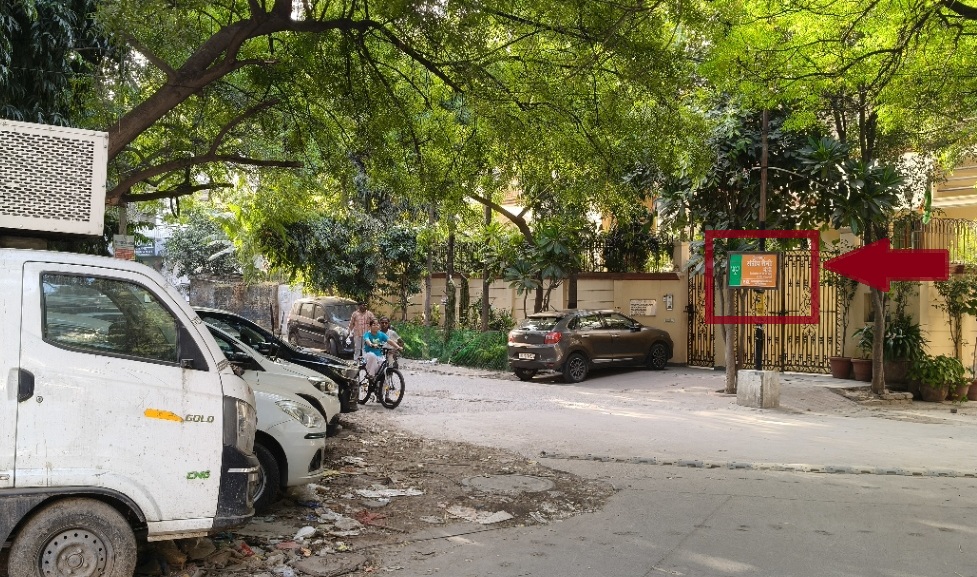
The location becomes even more noteworthy because it is near to residence of BJP Minister Sandeep Saini. Climate Samurai is mentioning this detail because of its relevance to the civic question raised by the site.
The presence of a residence identified by that name so close to the garbage accumulation makes the basic question even more difficult to ignore:
If a garbage dump this large can persist in such a prominent residential location, who within the civic administration is responsible for monitoring and clearing it?
Public records also place a Sandeep Saini at an address in Khirki Village, Malviya Nagar, in documents before the Central Information Commission. (Indian Kanoon)
However, Climate Samurai is not alleging that Sandeep Saini or the residents of the identified property dumped the garbage, nor is the photograph by itself evidence of any such involvement.
The accountability question is directed at the civic authorities responsible for waste collection, enforcement and maintenance of public spaces.
This is where Delhi’s waste-management claims face their real test
There is no reason to dismiss the government’s landfill-remediation work if the reported numbers are accurate.
Removing legacy waste from Delhi’s three giant landfill sites and reclaiming land is important.
Building additional waste-processing capacity is also necessary.
But neither achievement automatically means that Delhi has solved its waste problem.
In fact, the latest numbers underline why the challenge is much larger.
Delhi reportedly generates around 13,500 tonnes of municipal waste every day, while only about 60% is currently processed, according to the Indian Express report on the new facilities. (The Indian Express)
That means the city’s success cannot be judged simply by asking: “How much garbage has been removed from Okhla?”
The more important questions are:
How much waste is being segregated at source?
How much is actually processed?
How much is recycled or recovered?
How much reaches landfills?
How much ends up in unauthorised neighbourhood dumping points?
And most importantly: How many public spaces are being lost to garbage?
From “garbage mountains” to “garbage pockets”?
The danger is that Delhi could end up solving one highly visible problem while allowing thousands of smaller ones to multiply.
A massive landfill is easy to photograph.
A garbage heap hidden behind trees in a residential neighbourhood is less visible.
But for the people living next to it, the environmental and public-health consequences are no less real.
Our photographs show waste sitting beside trees and parked vehicles, close to homes and a temple. Open waste can attract flies and stray animals, produce foul odours and, during rain, contribute to contaminated runoff. Plastic and other lightweight material can also be dispersed by wind.
And when organic and plastic waste remain mixed, the possibility of recovering valuable material becomes more difficult.
That runs directly against the government’s stated objective of turning “waste into wealth
Delhi cananot measure cleanliness only at its landfills
Chief Minister Rekha Gupta recently described her Okhla visit as her “last selfie” with the garbage mountain, saying the garbage mountain would soon disappear. (Web India News)
The political symbolism is obvious.
But Delhi’s waste problem will not disappear when the last photograph is taken at Okhla.
It will disappear only when residents stop encountering garbage mountains on their streets. A landfill mountain shrinking in Okhla while a children’s park becomes a garbage dump in Malviya Nagar is not a contradiction the government can ignore.
The two things can be true at the same time: Delhi can make progress on legacy landfill waste and still have a serious failure in neighbourhood-level waste management.
The solution is not more publicity. It is a functioning chain of segregation → collection → transportation → processing → recycling/recovery → scientific disposal, backed by enforcement.
The questions Climate Samurai wants answered
1. Who is responsible for this dumping site in R Block, Malviya Nagar?
2. When was the location last cleared?
3. How much waste is collected from here every day?
4. How many penalties have been imposed under the ₹50,000 warning displayed at the site?
5. Where does the waste go after it is removed?
6. Is the waste segregated before transportation?
7. How many similar open dumping points exist across Delhi?
8. When will this area be restored as a children’s/public green space?
9. How does MCD reconcile such neighbourhood garbage dumps with claims that fresh waste is being processed round the clock?
10. Who will take responsibility if today’s temporary dumping point becomes tomorrow’s permanent garbage mountain?
The bottom line
Delhi does not have only a landfill problem. It has a waste-management chain problem.
The government’s reported progress in clearing legacy waste deserves scrutiny through data, not dismissed outright. But the same scrutiny must be applied to what happens after Delhi’s garbage leaves homes, markets and streets.
The Climate Samurai ground report from Malaviya Nagar shows why.
The garbage mountain may be shrinking at Okhla. But here, it has simply found another address.
And this time, it is sitting beside a warning board that says it should not be there.
Delhi’s real waste-management success will come not when the government takes its last selfie with a landfill—but when residents no longer need to photograph garbage dumps in their own neighbourhoods.