

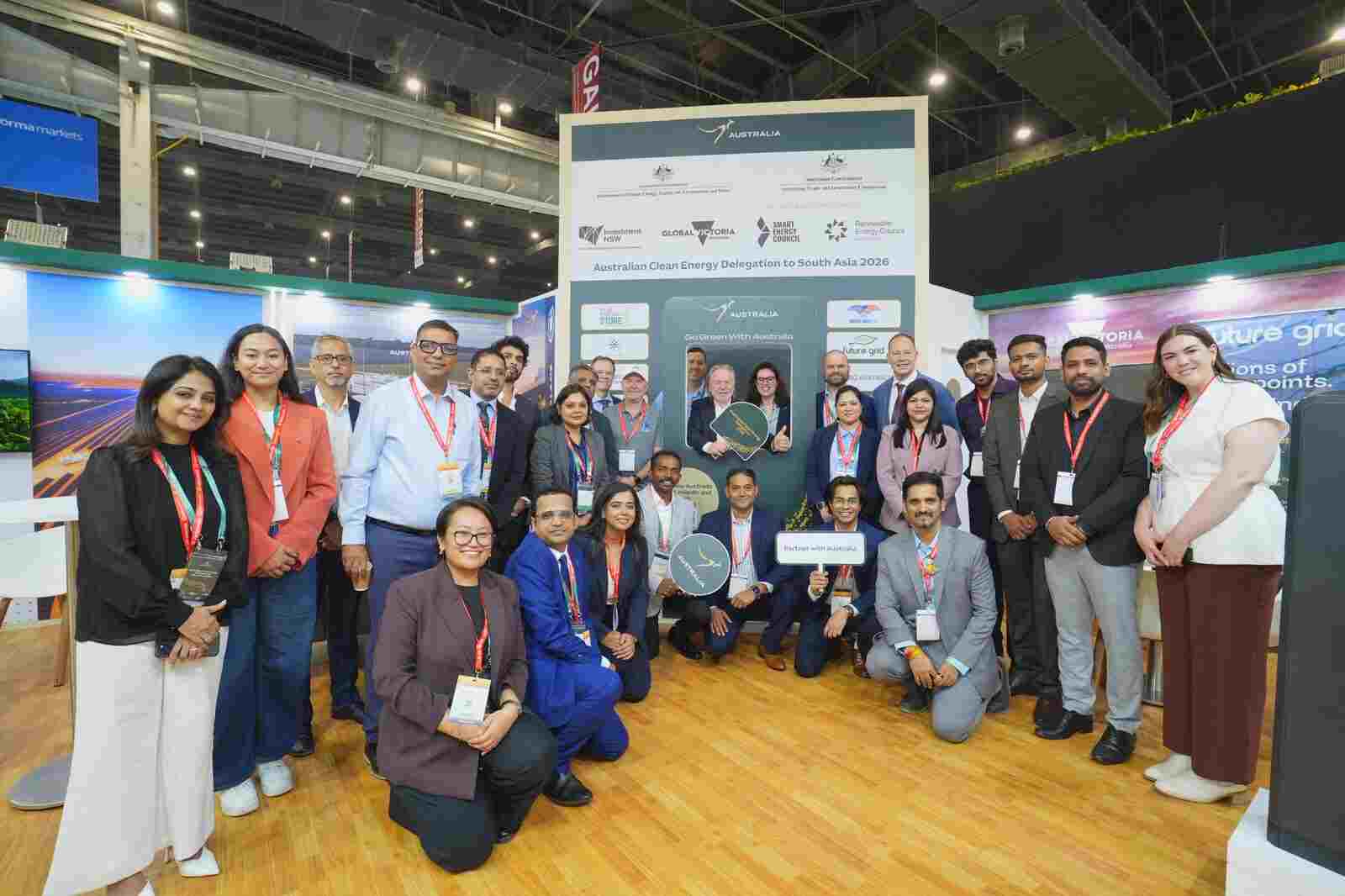
From battery storage and solar to hydrogen and AI, Australian clean-tech companies are exploring India’s growing demand for technologies, investment and resilient clean energy systems.
Australia is stepping up its clean energy engagement with India as a 32-member delegation representing 21 Australian companies participates in the Renewable Energy India Expo (REI Expo) 2026, seeking commercial partnerships across India’s rapidly expanding renewable energy market.
Led by the Australian Trade and Investment Commission (Austrade), the delegation is participating in the three-day exhibition being held from October 22 to 24 at India Expo Mart, Greater Noida.
The Australian Clean Energy Delegation visit is being delivered by the Smart Energy Council and the Renewable Energy Council Asia Pacific (RECAP), with support from the Australian Government’s Department of Climate Change, Energy, the Environment and Water, the Accessing New Markets Initiative, Investment NSW and Global Victoria.
What Australian companies are bringing to India
The Australia Pavilion at REI Expo 2026 features companies working across a wide range of clean energy technologies and services.
Their offerings include battery energy storage systems, solar technologies, renewable-powered water solutions, photovoltaic systems, renewable energy training, hydrogen technology, energy simulation, clean-tech solutions, solar installation services and artificial intelligence applications.
The delegation is using the expo to meet Indian businesses, investors and industry stakeholders and gain a closer understanding of the country’s renewable energy ecosystem.
Beyond showcasing products, the companies are looking for opportunities involving technology partnerships, commercial collaboration, market access and knowledge exchange.
India’s storage and grid needs create opportunities
India’s rapidly expanding renewable energy capacity is also creating new demand beyond solar and wind generation.
The growing penetration of variable renewable power is increasing the importance of energy storage, grid modernisation, system flexibility and resilient clean-energy supply chains.
These requirements could provide an entry point for Australian companies with expertise in energy technologies, storage, hydrogen and clean-energy systems.
For Australian businesses, India offers a large and growing market for deployment of clean technologies. For India, partnerships with international technology providers could help address some of the technical and infrastructure challenges associated with integrating larger volumes of renewable power.
India-Australia renewable energy partnership
The Australian delegation’s visit comes against the backdrop of a broader clean energy partnership between the two countries.
The India-Australia Renewable Energy Partnership, launched in November 2024, identifies eight areas for cooperation. These include solar photovoltaics, solar supply chains, renewable hydrogen, energy storage, the circular economy for renewable energy, two-way investment in renewable energy projects and allied areas, capacity building and other areas of mutual interest.
The partnership provides a framework for cooperation extending beyond individual technology sales to investment, skills development and supply-chain collaboration.
Austrade: India and Australia have complementary strengths
Murray Spence, Trade and Investment Commissioner at Austrade, said Australia and India bring complementary capabilities to the clean energy transition.
“Australian businesses offer specialised technology, innovation and system know-how across the clean energy value chain, while India presents significant opportunities for collaboration, technology deployment and market growth,” Spence said.
He added that REI Expo 2026 is providing a direct platform for Australian companies to connect with Indian industry and explore partnerships with long-term commercial potential.
Australia’s participation at REI Expo 2026 signals that the India-Australia clean energy relationship is increasingly moving from government-level cooperation towards business-to-business engagement and technology partnerships.
For India, the interest comes at a time when the energy transition is no longer only about adding renewable generation. The next phase will depend heavily on storage, transmission and grid flexibility, domestic and international supply chains, hydrogen, digital technologies and the ability to integrate clean power at scale.
For Australian companies, India represents an opportunity to expand into one of the world’s most closely watched renewable energy markets.
The success of these engagements, however, will ultimately depend on whether discussions at industry platforms such as REI Expo translate into actual investments, technology deployments and long-term commercial partnerships.