

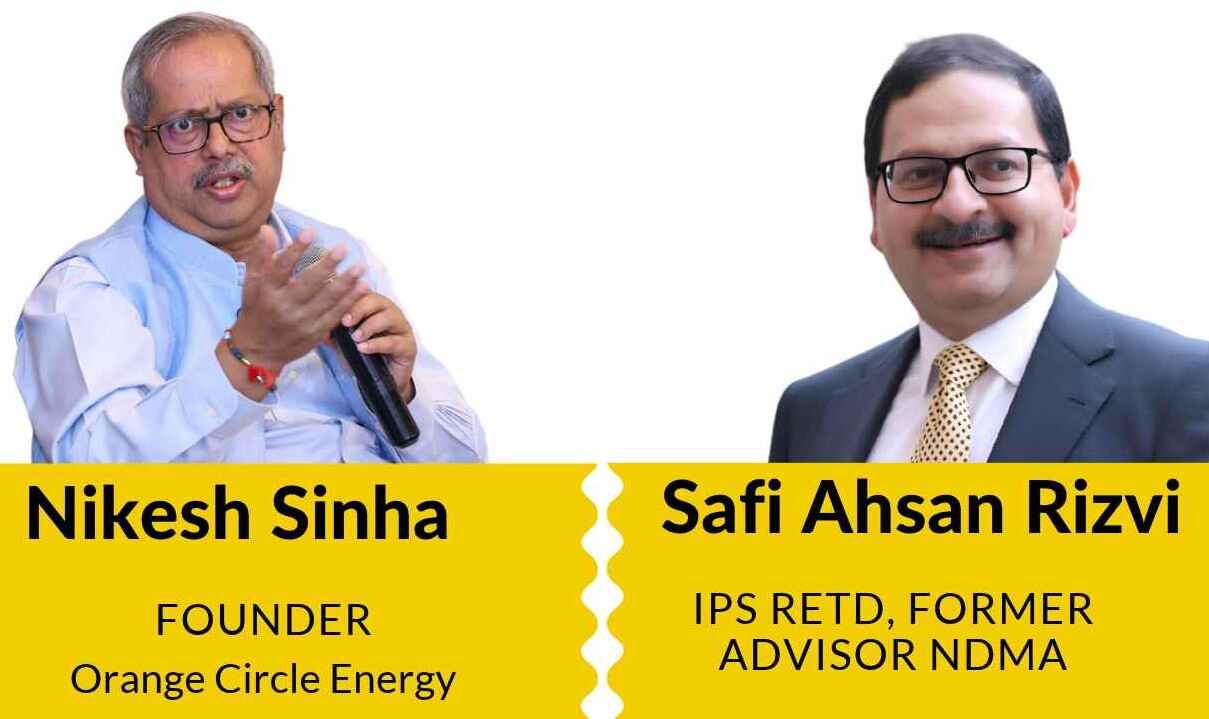
As India rapidly expands renewable energy capacity, Nikesh Sinha, Founder of Orange Circle Energy, and Safi Ahsan Rizvi, Risk Analyst, Geo-Strategist and Former Special Director, Intelligence Bureau, examine the growing challenges of grid infrastructure, power demand, climate resilience, investment and institutional coordination.
India’s renewable energy transition is gathering pace, with the country expanding its solar and wind generation capacity. However, the transition involves more than installing renewable energy projects. Transmission infrastructure, distribution networks, energy storage, financing and institutional coordination will play an equally important role in ensuring that electricity reaches consumers reliably.
The growing gap between renewable energy generation and grid infrastructure raises important questions about India’s preparedness for the next phase of its energy transition.
In this joint interview with Climate Samurai, Nikesh Sinha, Founder of Orange Circle Energy, and Safi Ahsan Rizvi, Risk Analyst, Geo-Strategist and Former Special Director, Intelligence Bureau, share their perspectives on India’s transmission infrastructure, electricity demand, decentralised energy systems, climate-related risks and the investments required to build a resilient power network.
1. Is India at risk of creating renewable energy capacity that the grid cannot efficiently absorb or deliver to consumers?
India is increasing renewable generation capacity at a rapid pace, but transmission and distribution infrastructure often take much longer to plan, finance and build. What are the biggest infrastructure bottlenecks facing the country today?
Nikesh Sinha, Founder, Orange Circle Energy:
India’s renewable energy push has been directly related to the availability of land in states. For example, Rajasthan and Gujarat have seen an extraordinary push in renewables because of the relative ease of land availability. Bihar and West Bengal have been laggards. Clearly, once you build infirm power capacity, your distribution and transmission lines are impacted. This was the case in India especially in the first decade of growth in the 2009-19 period. Government of India then moved very swiftly to re-organise its transmission and distribution networks in terms of efficiency of the networks as well as spread of the networks.
Safi Ahsan Rizvi, Risk Analyst, Geo-Strategist and Former Special Director, Intelligence Bureau:
This is a fact and not theory at all. India faces a clear risk of creating generation capacity that cannot be efficiently evacuated or utilised. Installed capacity is not the same as deliverable electricity. The success of India’s energy transition must therefore be measured not merely in gigawatts installed, but in electricity reliably delivered to consumers.
I feel, three structural mismatches exist:
- First, renewable generation projects can be commissioned much faster than transmission corridors, which require lengthy approvals, land access and construction.
- Second, renewable resources are concentrated in a few states, whereas demand is dispersed across the country, requiring substantial interstate transmission capacity.
- Third, distribution companies remain financially and technologically ill-equipped to absorb variable renewable power.
2. What needs to change in transmission planning and execution to prevent infrastructure from becoming the weakest link?
Right-of-way constraints, land acquisition, transformer shortages and long project timelines are repeatedly identified as barriers to transmission expansion. What changes are needed in planning and execution to prevent transmission from becoming the weakest link in India’s energy transition?
Nikesh Sinha, Founder, Orange Circle Energy:
Recent changes in the laws regarding transmission lines right of way issues have considerably reduced the burden on developers. However, the farmers are always very difficult to negotiate with. What is needed is all transmission lines should be treated as essential services and farmers compensation should be non-litigable.
Safi Ahsan Rizvi, Risk Analyst, Geo-Strategist and Former Special Director, Intelligence Bureau:
The underlying problem is not simply engineering capacity but institutional coordination. Transmission should be treated as strategic national infrastructure, with corresponding priority in planning, financing and execution. Three changes are essential.
- First, transmission planning must precede generation, with evacuation infrastructure approved and financed alongside renewable energy projects rather than after their commissioning.
- Second, right-of-way permissions, land acquisition and environmental clearances need predictable timelines, standardised compensation and stronger coordination between central and state authorities.
- Third, India must expand domestic manufacturing capacity for critical grid equipment, including transformers and high-voltage systems, while modernising procurement practices.
3. Are India’s electricity demand estimates ambitious enough to prepare for future consumption?
Electricity demand in the country is expected to rise sharply as manufacturing, cooling, data centres, electric mobility and urbanisation expand. Are India’s current power-demand estimates sufficiently ambitious, or could the country again find itself planning infrastructure after demand has already materialised?
Nikesh Sinha, Founder, Orange Circle Energy:
Electricity demand in the country has to be re-examined given the number of large scale uses of electricity that are being introduced in the country. The government is becoming increasingly supportive of private sector expansion in all sources of energy where security of generation is within Indian shores. The only issue is ambition led demand. India has always grown its supply as a demand led model. However, there is the other model of increasing supply across the country with a clear idea that demand will follow supply. Our ambition is tempered by the reality that all growth is a matter of resources more than anything else.
Safi Ahsan Rizvi, Risk Analyst, Geo-Strategist and Former Special Director, Intelligence Bureau:
India risks underestimating not only the scale but also the changing character of electricity demand. Three developments deserve particular attention.
- First, rising temperatures and air-conditioning penetration will create sharper seasonal and evening demand peaks.
- Second, manufacturing, electric mobility, artificial intelligence and data centres will introduce new concentrations of demand, often in locations inadequately served by existing infrastructure.
- Third, increasing household incomes and urbanisation will raise per-capita electricity consumption substantially.
Planning must therefore move beyond extrapolating historical consumption towards scenario-based forecasts incorporating economic growth, technology adoption and extreme weather. We should build infrastructure for the economy India aspires to become, not merely the economy it is today.
4. Can decentralised renewable energy reduce pressure on India’s national grid?
Renewable energy projects are usually located far from major consumption centres. How should India balance large renewable energy parks and long-distance transmission with decentralised solutions such as rooftop solar, storage and distributed generation? Can decentralisation meaningfully reduce pressure on the national grid?
Nikesh Sinha, Founder, Orange Circle Energy:
In fact this is being addressed by HVDC transmission which allows for long distance transmission of electricity. Distributed generation like renewables on roof would serve as a major source of grid stability also. Storage will bring about more depth in the transmission and consumption patterns than earlier but the impact will be seen over the next decade as the price of storage drops and its adoption increases significantly.
Safi Ahsan Rizvi, Risk Analyst, Geo-Strategist and Former Special Director, Intelligence Bureau:
India needs both, but their respective roles must be better differentiated.
- First, large renewable energy parks offer economies of scale and are indispensable for supplying industrial and metropolitan demand, although they require substantial long-distance transmission investment.
- Second, rooftop solar, distributed generation and local battery storage can reduce daytime demand on distribution networks, improve local reliability and defer some network investments.
- Third, decentralisation can enhance resilience by allowing critical facilities and communities to maintain essential services during wider grid disruptions, particularly when equipped with islanding capability.
However, distributed systems cannot eliminate the need for a strong national grid. The objective should be an intelligently integrated grid, combining centralised efficiency with decentralised resilience.
5. Is India’s power infrastructure prepared for increasing climate and disaster risks?
Energy security is no longer just about having enough generation capacity. Extreme heat, floods, cyclones and other climate-related events can disrupt transmission and distribution networks. Is India’s power infrastructure adequately prepared for increasingly severe climate and disaster risks? Should resilience become a mandatory part of infrastructure planning rather than an afterthought?
Nikesh Sinha, Founder, Orange Circle Energy:
This needs a full scale disaster modelling and in view these structures must exist as an exoskeleton on top of the current structure. I am afraid not enough thought is being given to this topic in India as we speak.
Safi Ahsan Rizvi, Risk Analyst, Geo-Strategist and Former Special Director, Intelligence Bureau:
India has made progress in disaster preparedness, but climate resilience is not yet sufficiently embedded across electricity infrastructure planning. Three priorities stand out.
- First, transmission towers, substations and distribution networks must be designed or retrofitted against location-specific hazards, including extreme winds, floods, heatwaves and landslides.
- Second, utilities need systematic vulnerability assessments, incorporating climate projections and multi-hazard risk mapping rather than relying exclusively on historical experience.
- Third, redundancy, distributed backup systems and rapid restoration capabilities must become integral to network design.
These investments may increase initial capital costs but substantially reduce future economic losses. Resilience should be a mandatory design criterion, not an optional expenditure justified after a disaster.
6. Where should India find the investment needed for transmission, storage and grid modernisation?
The energy transition will require enormous investment not only in generation but also in transmission, distribution, storage and grid modernisation. Where should the money come from, and how can India ensure that the push for private and domestic capital does not ultimately translate into higher electricity costs for consumers?
Nikesh Sinha, Founder, Orange Circle Energy:
India needs to unlock domestic capital to fund its infrastructure requirement. This would need changes in domestic insurance deployment as well as domestic pension corpus being used with specific targets in mind. Internal pools of capital should be put to use instead of lying in government balancesheets. We need a sovereign fund for infrastructure. India is an attractive market and such a move will draw large capital from other countries also.
Safi Ahsan Rizvi, Risk Analyst, Geo-Strategist and Former Special Director, Intelligence Bureau:
The financing challenge requires a differentiated approach.
- First, public investment and concessional multilateral finance should support strategic transmission corridors, grid resilience and infrastructure whose benefits extend beyond individual commercial projects.
- Second, private capital can play a larger role in transmission, storage and modernisation where predictable regulation and appropriate risk-sharing mechanisms provide reasonable returns.
- Third, distribution reform, lower technical and commercial losses, competitive procurement and better utilisation of existing assets are essential to containing consumer tariffs.
The cost of financing is as important as the amount of capital mobilised. The objective must be to reduce the lifetime cost of delivered electricity, rather than merely minimise the initial cost of infrastructure.
7. Who should be accountable when renewable generation outpaces grid infrastructure?
With India’s renewable energy growth depending on close coordination between central, state and private entities, who bears primary responsibility when power generation outstrips grid and evacuation infrastructure? What single institutional reform would best address this misalignment?
Nikesh Sinha, Founder, Orange Circle Energy:
Grid must lead the investment cycle. Renewable plants should always follow. What is also required is a clear 10 year and 20 year plan for the country which will help all stakeholders to plan their activities.
Safi Ahsan Rizvi, Risk Analyst, Geo-Strategist and Former Special Director, Intelligence Bureau:
Responsibility is presently fragmented among central agencies, state governments, transmission utilities, regulators and renewable energy developers. Three issues require attention.
- First, generation approvals and transmission readiness must become part of a common planning framework with enforceable milestones.
- Second, accountability must be clearly assigned when projects are commissioned without adequate evacuation capacity, including transparent reporting of delays and curtailment.
- Third, planning must integrate generation, transmission, distribution and storage rather than treating them as separate sectors.
The single most useful reform would be an empowered national–state integrated electricity planning mechanism, with statutory coordination responsibilities, common data and periodic public reviews of project readiness. India’s energy transition requires not simply more investment, but unified institutional accountability.