

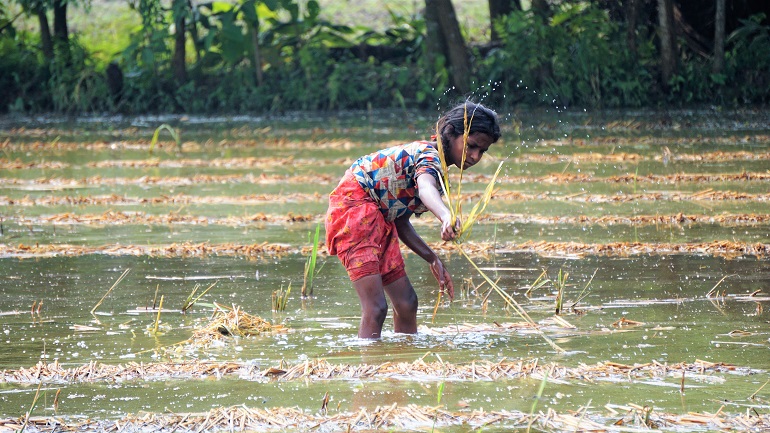
Extreme summer temperatures and erratic monsoons are threatening India’s food security. Discover how climate-resilient strategies, biological inputs, and policy support can protect paddy and other crops from the growing threat of climate change.
The consequences of climate change are beginning to take a toll on the Indian agriculture sector, which was thriving in the past. If this sector is subjected to further heat waves, both the economy and national food security will face a catastrophic challenge. Observations from the India Meteorological Department (IMD) indicate a discernible trend of elevated summer temperatures and more prevalent, severe heatwaves across key agricultural zones. This thermal stress interferes with the established phenological stages of crop development, frequently aligning with crucial reproductive phases. Climate-induced monsoon irregularities have only exacerbated these hydrological and periodic rainfall deficits, and it is resulting in agricultural devastation that was previously unthinkable.
The effects of climate change on crop physiology are severe. Continuous high temperatures impose stress on crops, which, in turn, inhibits essential processes such as photosynthesis. For several cereal crops, such as paddy (Oryza sativa) and maize (Zea mays), increases in temperature during the anthesis stage lead to insufficient pollen, decreased grain filling, and yield. Additionally, extreme temperatures increase the rate of evaporative water loss, which severely limits water availability, causing crop dehydration and inhibiting growth. Furthermore, early senescence adversely affects both the quality and quantity of the yield. In this context, biological interventions are poised to play a vital role in maintaining soil health and enabling agricultural systems to adapt to extreme climatic conditions.
Differential Vulnerability of Key Crops to Thermal Extremes
The growing and cultivation of rice paddy (Oryza sativa), which stands as a principal contributor to India’s food security, demonstrates particular sensitivity towards thermal extremes because of its high water requirements (which are further worsened by the extreme weather). Projections indicate a future decline in rice yield (across both irrigated and rainfed systems) in Uttar Pradesh under moderate (SSP2-4.5) and high (SSP5-8.5) emissions scenarios due to detrimental impacts of heat stress during flowering and grain-filling activities. However, paddy is not the only crop that is getting affected. Various crops such as maize (Zea mays) and leguminosae (pulses) are vulnerable to abscission of flowers and poor pod formation. Other horticultural crops such as tomatoes (Solanum lycopersicum), peppers (Capsicum spp.), berries (like strawberries (Fragaria spp.) and blueberries (Vaccinium spp.)), and nuts (like almonds (Prunus dulcis) and walnuts (Juglans regia)) are also affected by factors impacting fruit set; their quality and marketability suffer, leading to lower farm incomes.
Nurturing Agroecological Strength:
A Comprehensive StrategyTo address this concerning issue, adopting climate-resilient agricultural practices is the most effective approach, which should be implemented through specific, measurable crop strategies tailored to each region.
- Approaches for Cultivating Rice (Oryza Sativa): Embracing drought-resistant and heat-resistant crop varieties that have been developed by national agricultural research institutions is crucial. Implementing water-efficient irrigation techniques like Alternate Wetting and Drying (AWD) and Direct Seeded Rice (DSR) can significantly lower water usage. Enhancing water use efficiency can be accomplished through techniques like precision irrigation and improved water harvesting systems. Additionally, resilience can be strengthened by optimizing planting schedules, utilizing balanced fertilizers, implementing mulching practices, and managing crop residues in an effective manner. Furthermore, leveraging mycorrhizae, nitrogen-fixing bacteria, potash-mobilizing and phosphate-solubilizing bacteria biofertilizers to improve water and nutrient uptake, along with plant growth-promoting rhizobacteria (PGPR) to bolster resilience under less-than-ideal growth conditions, provides additional safeguards.
- Adaptation and Diversification Beyond Paddy: Utilizing drought-resistant crops such as millets (sorghum, Pennisetum glaucum, Eleusine coracana) is strongly advised in arid areas. Encouraging intercropping and mixed cropping with low-water-consuming plants can prove to be advantageous. For pulses, it is crucial to develop short-duration varieties and implement water-efficient irrigation techniques. The use of biostimulants improves their resistance to intermittent drought and heat stress. In horticulture, strategies focus on the utilisation of protected cultivation systems, promotion of drought-tolerant cultivars, precision irrigation, and applying agroforestry to mitigate temperature extremes. Biological control measures are also important in the management of pest and disease outbreaks, which may worsen due to climate change impacts in horticultural systems.
Strategic Collaboration Towards Sustainable Agriculture
Involving different stakeholders in climate change adaptation in agriculture is considered synergistic. Emphasis at this stage needs to be focused on investing in R&D to develop new crops and region-specific biological farming practices, as well as integrating dryland farming. This is strongly supported by the Indian Council of Agricultural Research (ICAR), which actively develops efficient strains of biofertilizers specific to different crops and soil types and promotes their use. Schemes like Paramparagat Krishi Vikas Yojana (PKVY) and Mission Organic Value Chain Development for North Eastern Region (MOVCDNER) further encourage the adoption of organic farming practices, which inherently include biological inputs.
Strong agricultural extension services, which include teaching farmers about biological inputs and their value, as well as how to use them, are important. The government’s Krishi Vigyan Kendras (KVKs) play a vital role in this through training and demonstrations. Additionally, the National Center of Organic and Natural Farming (NCONF) and its regional centers contribute by organizing training and awareness programs on organic farming and the use of bio-fertilizers.
Financial subsidies on resilient farming practices and comprehensive crop insurance schemes also help mitigate risks. The call for “financial subsidies on resilient farming practices” is directly addressed by policies like PKVY and MOVCDNER, which provide financial assistance to farmers for adopting organic inputs, including bio-fertilizers and bio-pesticides. The National Mission on Oilseeds and Oil Palm (NMOOP) and the National Food Security Mission (NFSM) also offer financial aid for the promotion of bio-fertilizers.
Strengthened market access for millet crops focused on climate change resiliency will also help increase supply. Supporting farmers’ organizations and encouraging community initiatives for effective information dissemination and collaborative strategies is crucial. A robust policy framework, combined with artificial intelligence and remote sensing technologies, will enhance the efficiency and effectiveness of monitoring assistance.
All things considered, the severe summer heat and its effects on agriculture in India pose a major challenge, but it is one that can be tackled. It is essential to explore biological solutions and agroecosystem strategies that will help India achieve its sustainable development goals while protecting farmers and the agricultural sector. Taking proactive steps goes beyond just farming; it is a strategic move by the government aimed at securing food supplies, boosting farmers’ incomes, and ultimately ensuring the country’s economic stability. The time for change and action is now.
AUTHOR

Mr. Harsh Vardhan Bhagchandka, President of IPL Biologicals