

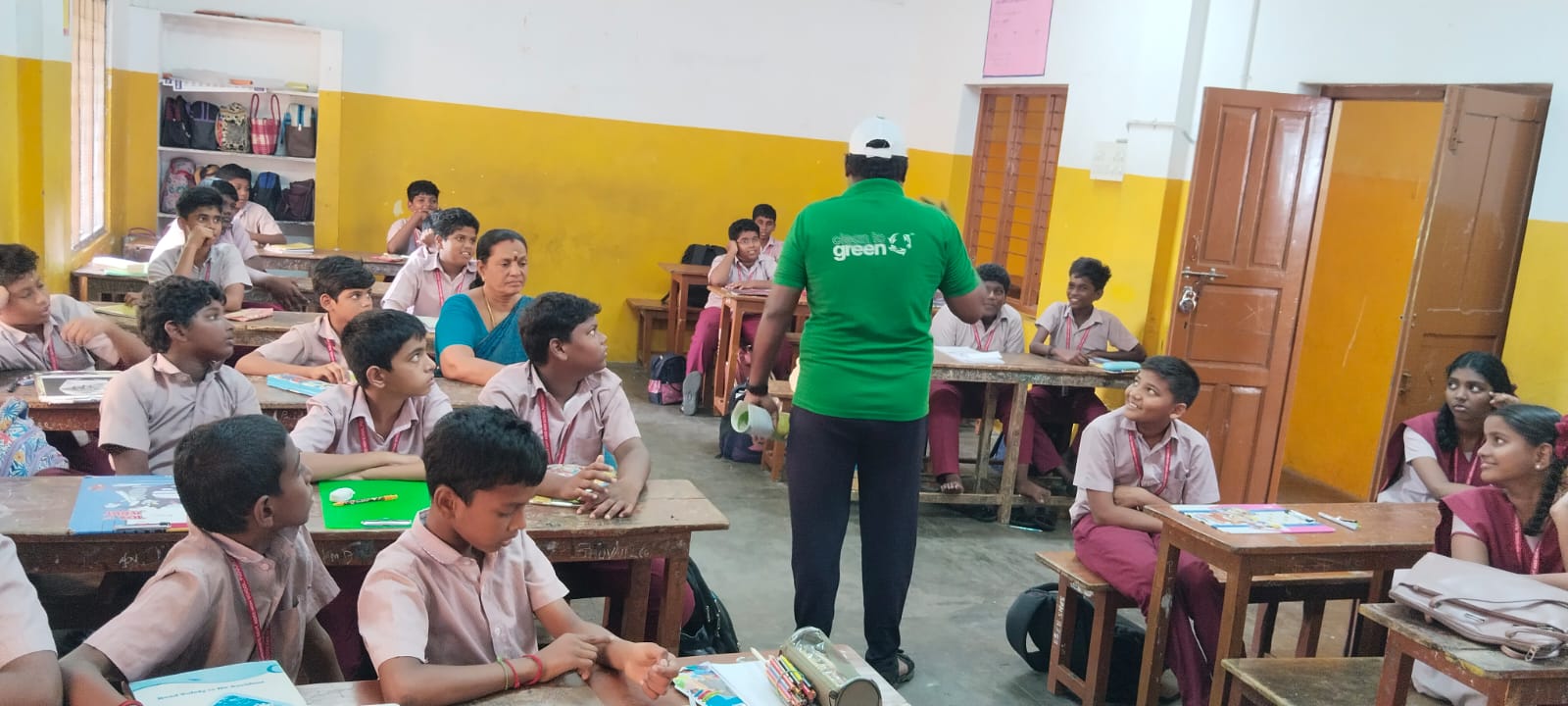
From e-waste collection drives to live waste-management facility visits, Clean to Green Society engaged students across Delhi, Puducherry and Gurugram in practical sustainability learning during August.
Environmental education is increasingly moving beyond classroom awareness, with students getting opportunities to see, understand and participate in real-world sustainability practices. In August 2026, Clean to Green Society (C2G) conducted a series of programmes across Delhi, Puducherry and Gurugram, combining awareness sessions, creative activities, e-waste collection and experiential learning.
Here are five key things to know about the initiative.
1. Clean to Green took sustainability lessons beyond the classroom
The August programmes focused on more than simply explaining environmental issues to students. Participants were introduced to e-waste management, waste segregation, recycling, responsible disposal, resource conservation and circular-economy practices.
The objective was to connect everyday behaviour with environmental impact and encourage students to take sustainability lessons back to their homes and communities.
2. Students used art to connect environmental responsibility with nation-building
At DAV Public School, Sector 7, Rohini, Delhi, C2G organised a drawing competition on August 13 around the Independence Day period.
Students were encouraged to explore the connection between responsible citizenship and environmental protection, using art to express their vision of a cleaner and greener India.
The activity positioned environmental responsibility not merely as an ecological concern but also as part of being a responsible citizen.
3. E-waste education reached students in Delhi and Puducherry
Training and awareness sessions were conducted at Societe Progressiste Government Aided High School in Puducherry on August 12 and at Government Co-ed Secondary School, Block 2, Geeta Colony, Delhi, on August 13.
The sessions covered practical aspects of e-waste segregation, recycling and safe disposal, while encouraging students to adopt more responsible consumption and disposal habits.
The Delhi programme also sought to encourage students to act as sustainability ambassadors, potentially influencing waste-management practices within their families and communities.
4. Gurugram initiative linked e-waste awareness directly to action
At ICFAI Business School (IBS), Gurugram, on August 11, Clean to Green combined an awareness programme with an e-waste collection drive.
This created a direct link between learning and action: students were not only introduced to responsible e-waste management but also given an opportunity to participate in the collection of end-of-life electronic products.
For students pursuing business education, the programme also brought concepts such as responsible consumption, resource efficiency and circularity into the context of future workplaces and institutions.
5. 55 students got a first-hand look at waste management
One of the month’s key initiatives was an educational visit by 55 students of Salwan Girls Senior Secondary School, Rajender Nagar, Delhi, to the RLG Mandoli Aggregation Centre on August 19.
Instead of learning solely from textbooks, students observed waste-management operations, including segregation, sorting, handling, storage and aggregation. They also learned about e-waste and battery waste management, responsible disposal and how collected materials move towards recycling.
The programme followed the learning approach “See it. Understand it. Practice it.” and reflected the National Education Policy 2020’s emphasis on experiential and competency-based learning.
Why this matters
India’s growing consumption of electronic products is making responsible e-waste management an increasingly important environmental challenge. Awareness alone, however, may not be enough to change behaviour.
Clean to Green’s August initiatives point towards a more action-oriented model of environmental education—teach the issue, demonstrate the system and give students an opportunity to participate.
According to C2G President Radhika Kalia, the organisation’s focus is on helping young people understand how segregation, responsible disposal, recycling and resource conservation work in practice, while enabling them to carry those lessons into their homes and communities.
Clean to Green’s wider reach
Clean to Green Society, a purpose-led non-profit launched in 2017, works on environmental awareness, responsible resource management and circular-economy participation in India.
The organisation says it has reached more than 50 lakh people through over 9,116 activities across 152+ cities, 28 states and eight Union Territories, alongside an above-the-line media reach of more than five crore.
Can India’s next generation turn sustainability education into everyday behaviour—from segregating waste at home to responsibly disposing of old electronics? Share your thoughts on social media tagging us there.