

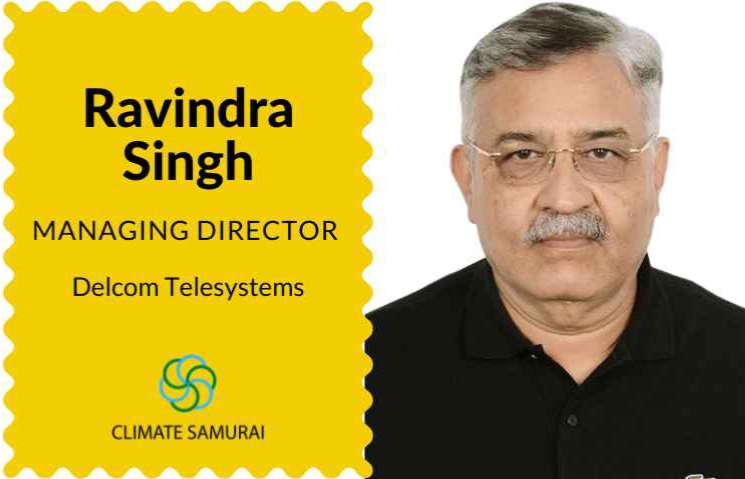
Delcom Telesystems MD Ravindra Singh on why surveillance, cyber-physical security and resilient digital infrastructure are becoming critical to India’s increasingly automated power grid
As India rapidly modernises its electricity infrastructure, the country’s substations and transmission networks are becoming more connected, automated and digitally managed. But this transformation also brings new vulnerabilities—from physical intrusion and equipment theft to cyber-physical threats and supply-chain risks.
In this exclusive interview, Ravindra Singh, Managing Director, Delcom Telesystems, discusses how cash-strapped DISCOMs can approach smart surveillance investments, the energy footprint of digital monitoring systems, designing hardware for India’s extreme weather conditions, and why utilities must treat physical and cyber security as interconnected parts of grid resilience. Here is the excerpt:-
Most state distribution companies (DISCOMs) in India are heavily burdened by debt and tight operating budgets. High-end IP surveillance and smart IT infrastructure sound great on paper, but how do you realistically convince cash-strapped utilities to prioritize advanced monitoring hardware over fundamental grid repairs?
Answer: For DISCOMs working within tight financial realities, we believe the conversation should not be framed as security versus grid repair. The more practical view is that monitoring and surveillance protect the very grid investments utilities are already making. When a utility modernises a substation, upgrades SCADA systems, improves feeders or invests in loss-reduction initiatives, security infrastructure helps ensure those investments remain reliable, accountable and protected.
A site that is not adequately monitored can remain vulnerable to theft, tampering, unauthorised access and…
In automated or unmanned substations, physical and electronic security are no longer optional enhancements; they are part of responsible asset protection. A site that is not adequately monitored can remain vulnerable to theft, tampering, unauthorised access and avoidable interruptions, all of which can dilute the efficiency gains that automation is intended to deliver.
Our approach is therefore pragmatic and phased. We advise utilities to begin with locations that are strategically important, high-risk or high-loss, and to align deployments with existing project and funding cycles. This allows utilities to strengthen resilience without placing an unrealistic burden on already constrained budgets.
Data centres, AI edge devices, and 24/7 HD video processing require continuous power and cooling. As India pushes for a cleaner, lower-emission energy ecosystem, how is Delcom ensuring that scaling up digital surveillance infrastructure doesn’t quietly balloon the operational carbon footprint of these substations?
Answer: It is important to clarify that substation monitoring infrastructure is very different from large data-centre-scale computing. The power consumed by surveillance, edge devices and recording systems is typically marginal when compared with core electrical assets such as transformers, switchgear and auxiliary systems.
Hybrid solar-DC arrangements and battery backup can further improve reliability while reducing dependence on diesel backup.
That said, Delcom recognises that every additional load matters when deployments are scaled across hundreds or thousands of sites. Our focus is on efficient system design: low-power edge devices, event-based recording, optimised storage, bandwidth management and site-specific power planning.
In remote or weak-grid locations, hybrid solar-DC arrangements and battery backup can further improve reliability while reducing dependence on diesel backup. As India’s power mix becomes cleaner, the sector will benefit from that transition, but our role is to ensure that the monitoring layer remains lean, efficient and proportionate.
Power transmission assets in India face severe conditions—from 48°C summer heats in the north to high humidity and monsoon flooding in coastal belts. Delicate IT and surveillance hardware often degrades quickly in the field. What real-world downtime data or field endurance record can Delcom share to prove these systems last in unconditioned, remote substations?
Answer: India’s substation environment is among the most challenging in the world, and it would be unrealistic to treat it like a controlled commercial IT installation. Our deployment philosophy starts with field conditions. Equipment must be selected and configured for the realities of dust, heat, rain, humidity, voltage variation, remote access limitations and prolonged outdoor exposure.
For high-temperature regions, that means extended operating temperature ranges and durable field cabinets. For coastal and monsoon-prone areas, it means weather-sealed enclosures, corrosion-resistant materials, sealed connectors, surge protection and proper earthing. The objective is not to impose a standard off-the-shelf solution everywhere, but to design each deployment around the operating environment so that avoidable failures are reduced.
What we can responsibly state is that durability, maintainability and lifecycle support are built into the design process…
From a public communication standpoint, we would avoid quoting a broad national uptime figure unless it is backed by audited, site-wise records and cleared for disclosure. Performance can vary by geography, voltage class, maintenance practices and exposure conditions. What we can responsibly state is that durability, maintainability and lifecycle support are built into the design process, and any specific performance claim should be made only with utility-approved data.
We hear a lot about “integrated cyber-physical threats,” but how directly does a surveillance gap translate to actual grid instability or blackouts in India? Can you share a concrete, anonymized instance where Delcom’s smart monitoring actively caught a threat early and prevented a major power disruption?
Answer: We take infrastructure confidentiality very seriously, so we cannot discuss client-specific incidents or operational details without formal approval. However, the broader point is clear: surveillance gaps can increase operational risk in critical power environments.
Smart monitoring helps utilities detect anomalies earlier, verify events, maintain audit trails and support faster…
A substation brings together physical assets, communication systems and control infrastructure. Unauthorised access, equipment tampering, cable theft or interference with communication links can have consequences that go beyond a local security breach.
That is why Delcom views cyber and physical security as interconnected. A perimeter breach, unrecorded access to a control area or tampering with field equipment can create cyber-physical exposure. Smart monitoring helps utilities detect anomalies earlier, verify events, maintain audit trails and support faster response before a situation has the opportunity to escalate.
Critical power infrastructure security is deeply tied to hardware supply chains, especially given concerns over foreign-made components and potential firmware backdoors. How much of Delcom’s hardware and software stack is manufactured or developed locally in India, and how do you guarantee complete hardware-level security to utility clients?
Answer: In critical infrastructure, no responsible organisation should claim absolute immunity from supply-chain or firmware risk. Our assurance to utility clients is based on a layered and verifiable security approach.
This includes sourcing from approved OEMs, following OEM hardening guidance, applying recognised security baselines, validating firmware through manufacturer advisories, segmenting networks, maintaining strict access controls, enabling logs and audit trails, and supporting review by the utility’s security teams.
The most credible commitment is not an absolute guarantee, but a disciplined process of selection, hardening, monitoring and periodic review that reduces risk in a transparent and accountable manner.