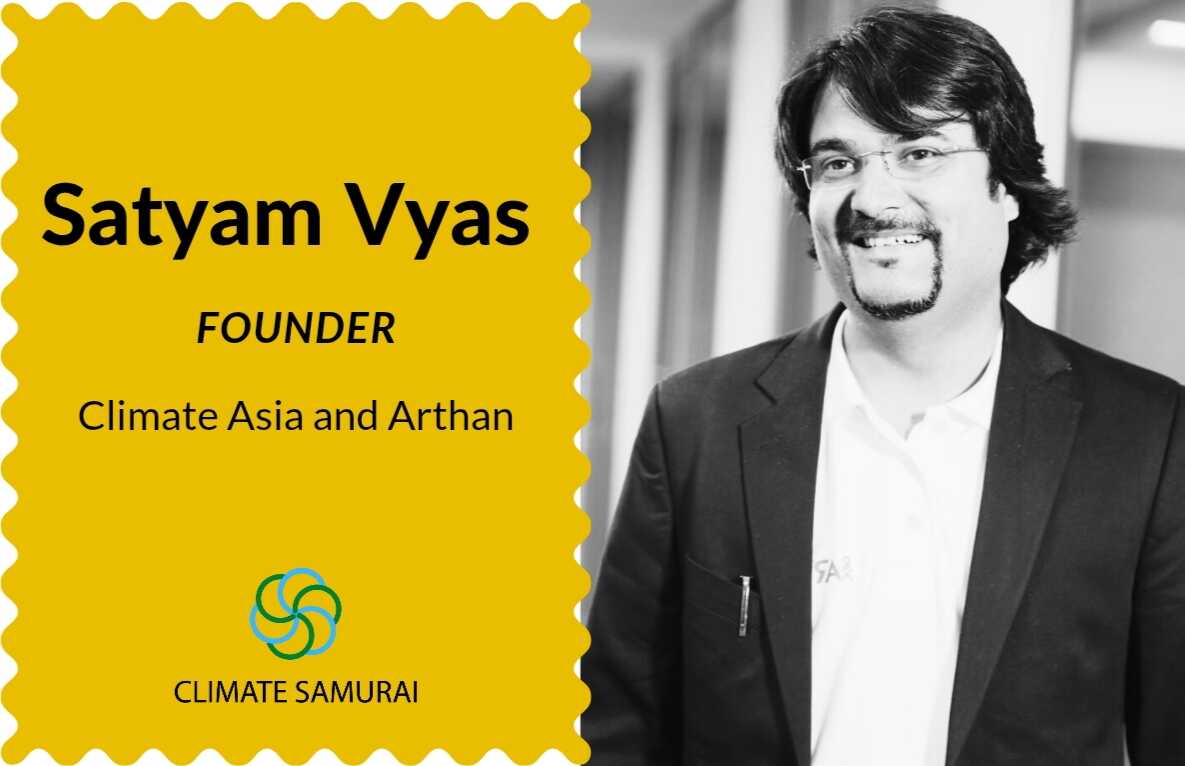
Satyam Vyas, the visionary behind Climate Asia and Arthan, has spent the last two decades shaping India’s social impact and climate ecosystem. In this exclusive conversation with Climate Samurai, he reflects on the power of grassroots leadership, the evolving nature of CSR, the urgent need for inclusive climate action, and the role of talent in building resilient, equitable systems. With deep insights from fieldwork to policy, Vyas makes a compelling case for trust-based collaborations and systems thinking as the future of social change. Here is the excerpt from exclusive interview:-
In your experience, how can social impact initiatives act as effective bridges between corporates, government bodies, and grassroots communities? Could you share a real-world example where this collaboration led to measurable, transformative outcomes?
When social impact efforts are rooted in trust and shared intent, they can act as powerful connectors. We have seen this firsthand. At our 2024 gathering in Bengaluru, we facilitated a dialogue between grassroots women leaders, funders, and agri-tech partners. One outcome was a collaborative soil health mapping initiative designed with community inputs at the core. It was not a case of tech being handed down but shaped alongside those working the land. That kind of partnership, built on mutual respect and learning, is what we need more of.
“Whether it is climate adaptation or education, systems are not always designed to respond to the day-to-day realities of the people they are meant to serve.”
What are the most persistent challenges you’ve encountered at the grassroots level, whether in climate action, livelihoods, or education?
One recurring challenge is the lack of consistent support structures for community-based organizations. They often operate with limited resources and even more limited visibility, yet their impact runs deep. There is also a gap in how knowledge from the ground is treated. Too often, it is seen as anecdotal rather than as legitimate expertise. And across sectors, whether it is climate adaptation or education, systems are not always designed to respond to the day-to-day realities of the people they are meant to serve.
Do you believe there is a fundamental disconnect between policy frameworks and the lived realities of vulnerable communities?
Yes, and it shows up in big and small ways. Many policies are created without truly engaging the communities most affected. This leads to programs that miss the mark or don’t last. That is one of the reasons we curated the Mitti Se Niti Tak session at our 2025 conference. It brought policymakers and grassroots leaders together, not as token participants but as equal contributors. We need more of that kind of dialogue where listening is taken as seriously as planning.
Our digital tools are built to be accessible, bilingual, and grounded in lived realities, not just theory
How does Climate Asia actively incorporate grassroots voices into its programs, digital tools, and advocacy efforts? What mechanisms ensure those voices are not just heard but are instrumental in shaping strategy?
At Climate Asia, we believe that those closest to the challenges are also closest to the solutions. Our role is not to speak for grassroots actors but to create the systems and platforms where they can lead. Through our flagship programs like the Green Accelerator Program (GAP) and EquiLead, we work with civil society organizations across Asia. These organizations are deeply embedded in local contexts, and their voices shape every aspect of our strategy, from curriculum design to policy advocacy. We institutionalize grassroots input through peer learning, digital resource hubs and capacity building sessions that capture field insights in real time. Our digital tools are built to be accessible, bilingual, and grounded in lived realities, not just theory. And when we advocate, we do so with our partners, not just on their behalf.
The program aims to bridge the talent gap in climate finance by aligning financial expertise with climate action goals.
Is the social impact sector attracting the kind of talent it truly needs? Where do you see the most critical gaps—in leadership, strategic thinking, or community understanding?
We are definitely seeing more people drawn to purpose-driven work, which is encouraging. But what is still missing is the kind of sustained support that helps this talent grow within the sector. Many early-career professionals need better exposure to how things actually work on the ground and many grassroots changemakers need support to step into leadership roles. There is also a need to bridge the gap between idealism and systems thinking, so talent can channel their passion into meaningful outcomes.
Through Arthan, you’ve built platforms focused on jobs and skill development. What models of training or fellowships have proven most effective in building capacity for the development sector?
At Arthan, we have seen that the most effective programs are those that combine practical exposure with continuous mentorship. We have designed and supported multiple fellowships in the sector. For example a 12-month program designed to equip midcareer finance professionals from the Global South with the skills, knowledge, and networks needed to transition into the nonprofit climate finance sector. The program aims to bridge the talent gap in climate finance by aligning financial expertise with climate action goals. Programs that prioritize contextual learning and cross-sector exchange tend to have the most durable impact.
“We’re also developing a “Green Talent Initiative” to bridge CSOs with experienced professionals seeking meaningful transitions into climate work.”
What innovations are you exploring to attract and retain top talent in this space?
Both at Arthan and Climate Asia, we are investing in building ecosystems, not just roles. We are experimenting with hybrid, mission-aligned pathways that allow professionals to move between sectors without losing purpose or momentum. For instance, we launched a Climate Fellowship that embeds young professionals in grassroots organizations working on adaptation, while giving them mentorship from global climate experts. We’re also developing a “Green Talent Initiative” to bridge CSOs with experienced professionals seeking meaningful transitions into climate work. Beyond roles, we focus on learning journeys, leadership labs, and peer networks to retain and grow high-potential talent.
“A more integrated support system would mean funding models that trust local wisdom and co-created metrics of success which reflect community ownership and resilience.”
How do you envision the evolving role of NGOs and social enterprises in translating complex local challenges into actionable, scalable strategies? What would a more integrated support system between grassroots actors and institutional funders look like?
NGOs and social enterprises are no longer just implementers, they are solution architects. They sit at the intersection of trust, knowledge, and agility. Their proximity to communities allows them to decode complex, intersecting challenges, whether it’s climate vulnerability, gender disparity, or livelihood fragility and translate them into holistic, scalable responses.But for that translation to work at scale, we need systemic alignment. A more integrated support system would mean funding models that trust local wisdom and co-created metrics of success which reflect community ownership and resilience.At Climate Asia, we try to model this through our accelerators, supporting CSOs not just with funds, but with strategic planning, climate science training, gender equity frameworks, and digital tools. This kind of deep capacity-building enables grassroots organizations to not just pilot good ideas, but to own and lead solutions across regions and sectors.
Are CSR initiatives still too compliance-driven, or are you seeing a shift toward more systemic, long-term investments in communities? What does a truly impactful CSR partnership look like in 2025?
There is a bit of both. Some CSR programs still follow a checklist model, but we are also seeing encouraging shifts. The most impactful partnerships are the ones where companies invest time, not just money. In 2025, an effective CSR partnership means building deep relationships with community partners, giving them room to shape the work, and staying in it for the long haul, even when results take time.
“We try to design programmes that address both climate goals and development needs at the same time”
Climate Asia sits at the intersection of environment, equity, and employment. How do you balance urgency in climate action with the need for inclusive development?
For us, it has always been about grounding climate action in people’s lives. If an intervention does not work for the community, if it does not create jobs, protect livelihoods, or include those who are often left out, it is not going to last. We try to design programmes that address both climate goals and development needs at the same time, whether it’s through local innovation, regenerative farming, or community-led adaptation strategies.
In what ways are you reframing climate discourse to better resonate with communities in the Global South?
Climate action in the Global South has to be grounded in dignity, opportunity, and equity, not just emissions and carbon math. We are reframing the discourse by connecting climate to everyday realities: water access, food security, women’s leadership, and livelihoods.For example, when we talk to rural women farmers, we don’t start with “climate resilience.” We talk about erratic rainfall, loss of crop yield, the burden of unpaid labor. Then we connect those lived experiences to climate adaptation strategies. This reframing makes climate action relevant and empowering, not abstract.We also emphasize the opportunity side of the crisis. India stands to gain millions of green jobs by 2030, but only if we invest in green skill-building for the most vulnerable. Our programs focus heavily on climate workforce readiness, especially for women and marginalized communities.By embedding gender equity and organizational development into climate narratives, we’re shifting the discourse from charity to capability, from victimhood to leadership.
For Climate Asia, this means scaling our accelerator program across South Asia, seeding local climate hubs,
With two decades behind you and massive systemic shifts ahead, what’s the next big challenge you’re preparing for? What’s your vision for Arthan and Climate Asia over the next five years?
Over the next five years, we’re preparing to meet the challenge of building a climate-resilient economy that includes everyone, not just in policy but in practice. For Climate Asia, this means scaling our accelerator program across South Asia, seeding local climate hubs, and training 10,000 grassroots professionals in climate and gender-responsive planning. For Arthan, our vision is to become the talent backbone for the impact sector, supporting 5,000 organizations annually through leadership practice, OD consulting, and a learning platform for the social workforce. The deeper vision is systems-level: embedding equity, climate, and human capital development into the DNA of every institution we work with.
From Pratham to now, what has been your most humbling learning as a leader in the social impact ecosystem? What advice would you give to the next generation of social entrepreneurs?
One of the most humbling lessons came early in my journey with Pratham, when I realized that proximity doesn’t guarantee understanding. You can spend years in the field and still miss the quiet wisdom communities carry. Over time, I have learned that real leadership often means stepping back, letting others lead, make mistakes, and find their own voice. My advice to the next generation: Don’t chase scale before trust. Show up consistently, build institutions that outlast you, and measure success not in visibility, but in how many others you enable to lead.