

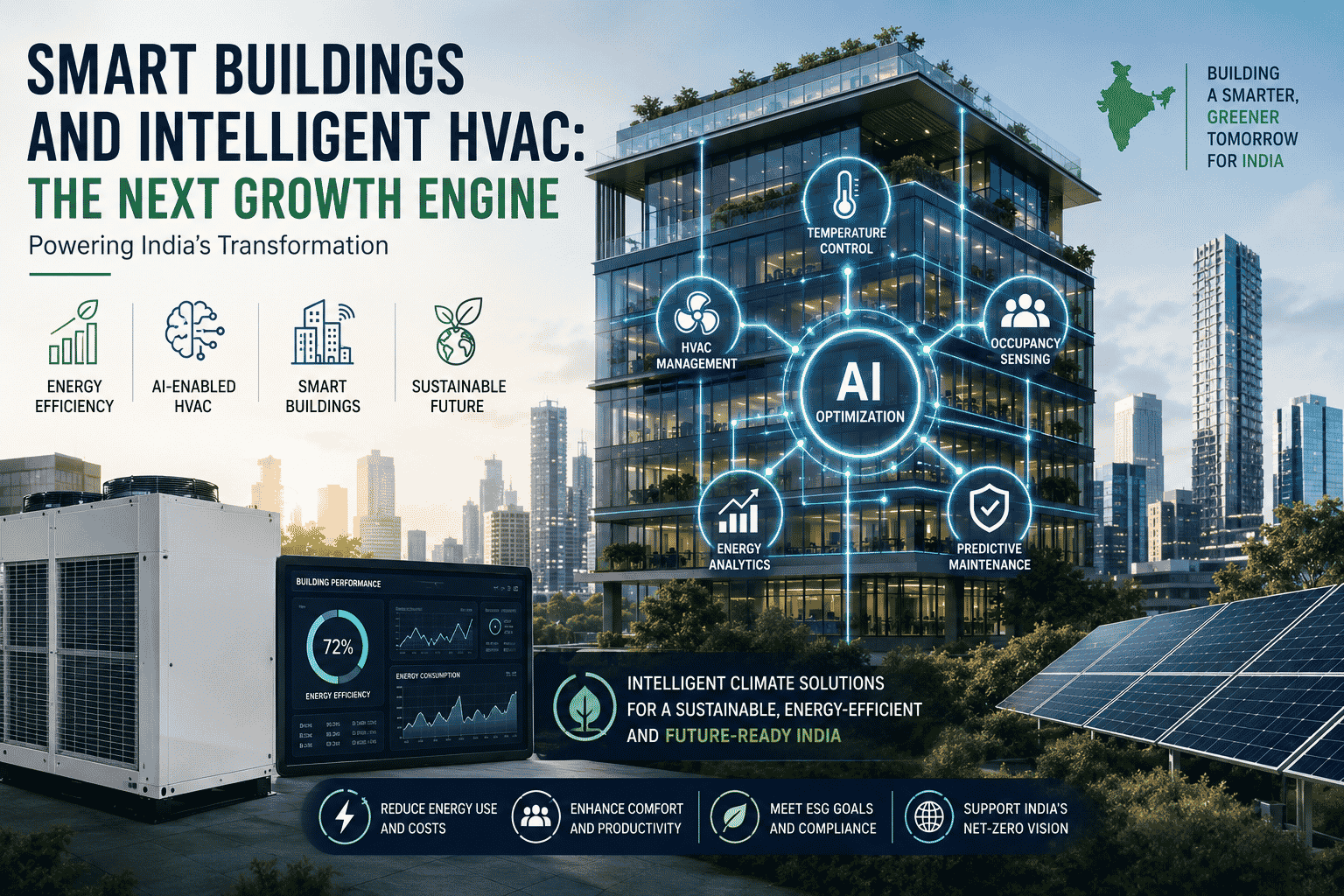
With cooling demand projected to surge and buildings consuming nearly one-third of India’s electricity, AI-enabled HVAC and smart building systems are emerging as critical drivers of energy efficiency, sustainability and economic resilience.
India stands at a pivotal moment in its growth story. As cities expand, industries scale, and digital infrastructure accelerates, one question has become central to the nation’s future: How efficiently can our buildings consume and manage energy? Buildings already account for one of the largest energy loads in the country. According to the International Energy Agency (IEA), they consume nearly 33% of India’s total electricity—a number expected to rise sharply by 2040.
Against this background, an important shift is underway. Built infrastructure is transforming from passive energy users into intelligent, performance-driven assets powered by digital, AI-enabled HVAC technologies. This shift is emerging as one of the most promising growth engines for India’s next phase of development.
India is undergoing one of the world’s most rapid urban transitions. By 2030, nearly 600 million people are expected to live in cities, driving massive expansion across commercial real estate, manufacturing, data centers, healthcare, airports and logistics. This rapid expansion is driving a sharp rise in energy demand, especially for cooling. HVAC systems alone contribute 40–60% of total energy usage in commercial buildings, and India’s cooling demand is projected to grow eightfold by 2037–38 as per the India Cooling Action Plan (ICAP).
To sustain economic progress while mitigating climate and grid pressures, energy efficiency must evolve from an operational afterthought into a strategic design and investment priority.
How Intelligent HVAC Works
Among all building systems, HVAC offers one of the most impactful opportunities for large-scale energy optimisation. Once focused solely on comfort, modern HVAC solutions now integrate advanced sensors, connected platforms and AI-driven analytics that transform how buildings operate.
Intelligent HVAC systems continuously monitor parameters such as occupancy, temperature patterns, humidity levels and energy consumption. By adjusting cooling and ventilation dynamically based on real-time needs, they significantly reduce energy waste.
For businesses, the benefits are substantial. Energy and operating costs decrease, equipment life is extended through predictive maintenance, and indoor air quality and thermal comfort improve. These enhancements translate into better occupant well‑being, higher productivity and more consistent performance across workplaces, hospitals and educational environments.
A compelling example comes from India’s fast-growing data centre sector. In a recent Trane India project, a global data centre provider faced high-density cooling challenges and the need for uninterrupted uptime. By deploying advanced HVAC systems integrated with intelligent controls, the facility was able to optimise cooling efficiency while maintaining strict environmental conditions. This not only reduced energy consumption but also improved reliability and enhanced operational resilience, demonstrating how intelligent HVAC can address both sustainability and mission-critical performance requirements.
Smart Buildings as Integrated Systems
The next stage of progress lies in connecting intelligent HVAC systems with broader smart building ecosystems. These integrated environments bring together HVAC, lighting, security, energy management and automation on a unified platform that can be monitored and optimised as a whole.
Through advanced analytics and digital dashboards, facility managers gain far greater visibility into building performance. This allows them to identify anomalies early, minimise inefficiencies and make informed decisions that enhance operational effectiveness over time.
For commercial developments, data centres and industrial facilities, such insights enable portfolio‑level energy optimisation, meaningful operational savings and stronger sustainability performance. In a digital‑first economy, buildings are no longer static physical structures; they are intelligent infrastructure assets that continuously generate insights to improve efficiency, resilience and long‑term value.
ESG and Regulatory Momentum
The rising importance of environmental, social and governance (ESG) goals is accelerating the adoption of smart building technologies. Investors, global customers and regulators are closely evaluating corporate environmental footprints, especially energy consumption and emissions.
As a result, digital and data-driven efficiency is transitioning from compliance to competitive advantage. Organisations that invest early in intelligent infrastructure can better manage costs, meet sustainability targets and build stakeholder trust.
India’s regulatory landscape is also evolving, with increasing focus on energy-efficient construction and green building standards. Combined with corporate decarbonisation commitments, this is driving market demand for advanced technologies. Smart HVAC systems integrated with AI-enabled building management platforms are becoming crucial tools for tracking and reducing carbon emissions transparently and effectively.
At the national level, India’s commitment to achieving net-zero emissions by 2070 underscores the need for a transformative shift in how buildings operate.
The Way Forward
As renewable energy adoption grows, smart building technologies will play a critical role in balancing demand and supply. Intelligent platforms can align building operations with grid conditions, optimise consumption patterns and support a more flexible and resilient energy ecosystem.
India’s next phase of growth will be defined not just by the scale of infrastructure development, but by how intelligently that infrastructure functions. This calls for coordinated action for stakeholders across the ecosystem:
- Developers must priorotise intelligent HVAC and smart building systems at the design stage rather than as retrofits.
- Businesses should accelerate the adoption of digital platforms to improve efficiency, reduce costs and meet ESG goals.
- Policymakers can further strengthen this transition by aligning standards, incentives and regulations with the net‑zero vision.
Buildings that can sense, analyse and optimise their own performance will be the backbone of sustainable and economically resilient cities. As India continues its journey toward becoming a global economic powerhouse, smart buildings powered by AI-enabled HVAC systems will play a pivotal role in shaping a more sustainable, energy-efficient and future-ready urban landscape.
In this transformation, intelligent climate solutions are not simply improving building performance, they are powering the next chapter of India’s growth story.
Author

Ajit Venkataraman, Vice President, Trane Technologies India