

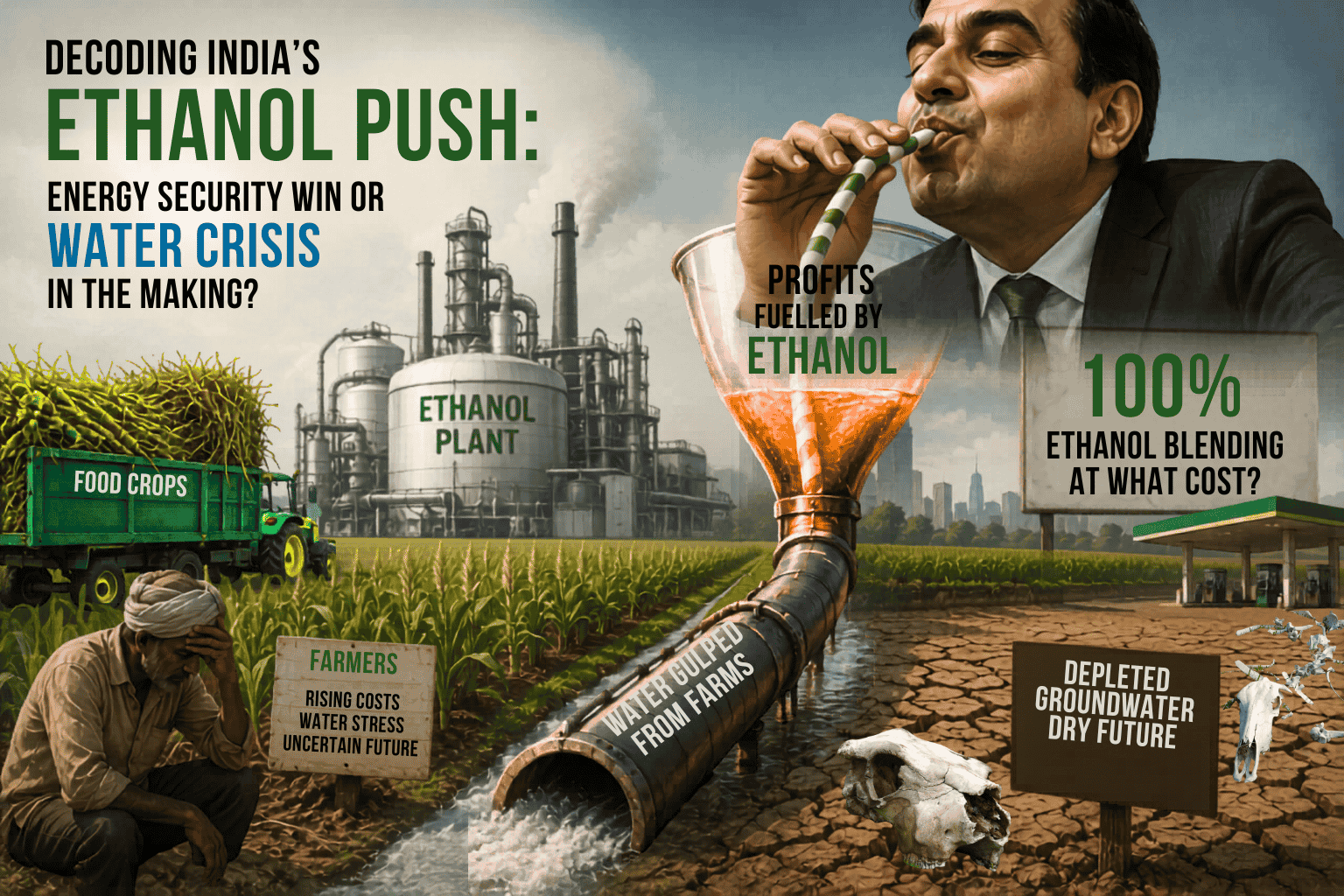
India’s aggressive ethanol blending mission may reduce oil imports and boost homegrown industries, but experts warn it could deepen groundwater depletion, strain food security, and slow the transition to EVs and green hydrogen.
Water shortages might come knocking soon as the aggressive ethanol blending strategy of India—advocated by Road Transport and Highways Minister Nitin Gadkari—is being touted as a decisive step toward energy independence. Emerging data and expert warnings suggest the policy could trigger a parallel crisis: severe water stress, with far-reaching implications for agriculture, electric vehicles (EVs), and India’s hydrogen ambitions.
Energy Security vs Water Security: A Growing Policy Conflict
Starting with farmers, Gadkari pushes ethanol made from sugarcane, maize, or rice to cut reliance on foreign oil. Because of unrest in places like West Asia, filling tanks locally matters more now. His aim? Mix ethanol into every drop of fuel sold here. Seen by some as eco-friendly, this alcohol-based fuel links agriculture directly to energy needs.
Gadkari’s vision of 100% ethanol blending is rooted in reducing crude oil imports and insulating India from geopolitical shocks like the ongoing tensions in West Asia. Ethanol, a biofuel derived from crops such as sugarcane, maize, and rice, is positioned as a “green” alternative.
However, experts including Anjal Prakash warn that this transition is not as sustainable as it appears.
- 1 litre of ethanol from rice = ~10,790 litres of water
- Maize = ~4,670 litres
- Sugarcane = ~3,630 litres
This creates a troubling absurdity:
India is burning water-intensive crops to produce fuel in a country already facing a groundwater emergency.
According to NITI Aayog, 21 major cities could run out of groundwater by 2030—a crisis that ethanol expansion may accelerate.
Homegrown companies will benefit from India’s Ethanol Economy!
Yes! You heard it right folks, because India’s Ethanol Economy isn’t just fuelling our cars—it’s fuelling a heartwarming success story that would make even the most seasoned venture capitalist weep.
Homegrown companies working in the sector may act as propellant towards India’s ethanol economy. As our honourable Road Minister pushes the pedal to the metal on ethanol blending, we are witnessing the majestic rise of “homegrown” champions. Because, really, why look for global solutions when the solution is sitting right at the dinner table?
Companies like Cian Agro Industries & Infrastructure Ltd—have seen explosive growth, their journey is a true underdog tale—if your definition of an “underdog” involves a spectacular trajectory that defies the standard laws of economics:
- 2017: A modest turnover of ₹100 crore.
- 2025: A casual leap to ₹1,000+ crore in revenue.
(as perGrowwand Zauba Corp).
That is a 10x growth in less than a decade. Some might call it “unprecedented market synergy” or “immaculate timing.” Others, particularly those pesky critics with a penchant for paperwork, might call it an interesting “policy-business overlap.” We prefer to think of it as part of Make In India or a localized version of the Atmanirbhar Bharat dream, where the “Bharat” in question just happens to have a very familiar last name.
Sacrificing Water for Wealth
Of course, there’s the minor, insignificant issue of a looming water crisis—since thirsty crops like sugarcane are the lifeblood of this ethanol gold rush. But let’s not get bogged down in thirst! Our countrymen must be “geared up” for this global shift. Who needs groundwater when you have 20% blended fuel and the warm, fuzzy feeling of supporting local entrepreneurship?
The Beauty of “Alignment”
Critics, in their usual joyless fashion, are pointing at incentive structures that seem specifically tailored to favor certain expansions. They talk about “transparency” and “fair competition” as if those aren’t just archaic obstacles to a well-oiled family machine.
In the world of the Ethanol Economy, the line between public policy and private profit isn’t just blurred—it’s been completely paved over with high-quality bitumen.
Bottom line: If you aren’t seeing 900% growth in your family business, are you even trying to save the planet?
Sugar & Ethanol Lobbies
States like Maharashtra, Uttar Pradesh and Karnataka already hubs for sugarcane cultivation, stand to gain from:
- Increased distillery investments
- Government procurement support
For Farmers on short term and long term?
Farmers may benefit from:
- Assured demand for crops like maize, rice, sugarcane
- Better price realization
But long-term risks include:
- Soil degradation
- Falling groundwater levels
- Crop vulnerability
Who will pay the price?
Water-Stressed Regions
Regions like Vidarbha, Marathwada, Punjab, and Haryana are already facing groundwater depletion. Ethanol production clusters in these regions could:
- Intensify water scarcity
- Reduce drinking water availability
Public Distribution System (PDS)
Diverting rice for ethanol:
- Reduces food availability for vulnerable populations
- Signals a shift from food security → fuel security
National Academy of Agricultural Sciences in its strategy paper 2024 notes that sugarcane and paddy (rice) together consume about 70% of India’s irrigation water, raising sustainability concerns. This heavy water use is a key reason for promoting maize as a more environmentally sustainable alternative.
In crop diversification strategies, the document suggests replacing upland rice in Eastern India (low productivity areas) with maize. This shift could reduce groundwater usage, improve resilience to climate variability, and provide farmers with new income opportunities.
Environment
Ethanol plants generate vinasse, a toxic wastewater:
- Can contaminate groundwater
- Adds to ecological stress if untreated
The NAAS in the paper noted that untreated effluents from ethanol plants can cause soil and water pollution, so strict compliance with environmental standards is necessary.
Circular Economy Approach: Wastewater is framed as a resource—processed effluents can be converted into biogas, compost, or irrigation water, aligning with sustainable agriculture and energy goals.
Is India’s EV and Hydrogen Plans still intact?
Electric Vehicles (EVs): A Strategic Slowdown!
India has been simultaneously pushing EV adoption through schemes like FAME . However:
- Ethanol blending supports internal combustion engines (ICEs)
- Automakers may delay full EV transition
- Oil marketing companies continue investing in liquid fuels
Net effect: Ethanol could act as a transition fuel, but also risks locking India into ICE dependency longer than necessary.
Green Hydrogen: Competing for Policy Attention
India’s hydrogen ambitions under the National Green Hydrogen Mission aim to decarbonize heavy industry and transport.
But ethanol shoving may:
- Divert policy focus and subsidies
- Compete for renewable energy and water resources
Hydrogen production itself requires significant water (electrolysis), creating a resource competition between two “green” fuels.
Biggest Question: Is Ethanol Truly Green?
Ethanol is often marketed as carbon-neutral, but India’s model raises serious concerns:
- Water footprint is unsustainable
- Food crops are being converted into fuel
- Groundwater depletion is accelerating
- Pollution risks from distilleries persist
Ethanol plants are expanding in already water-stressed sugarcane belts—intensifying ecological imbalance.
India’s ethanol push is not intrinsically flawed, but its recent execution is ecologically misaligned.
What needs urgent correction:
- Shift from food-based ethanol → waste-based ethanol (2G ethanol)
- Cap expansion in water-stressed regions
- Integrate water accounting into energy policy
- Balance ethanol with faster EV and hydrogen adoption
Trying to fix its energy reliance, India might be making water shortages worse instead. A single problem gets attention while another quietly grows beneath the surface.
As we wrap up this article here we leave with this question to you, question is not whether ethanol is green, but: Green for whom, and at what cost?
Do share your thoughts tagging us on any of the social media platforms.